I don't post much anymore. In fact, my engagement with the medical community, especially online, has plummeted over the past year. That's been partially by circumstance, but in many ways by design. For my own sanity, speaking less to and about doctors - and consequently more about things other than medicine and to more non-physicians - has been extremely beneficial.
Much of the reason this has been beneficial stems from a deep and unfortunately persistant disappointment I've had in this profession. While most physicians are well-intentioned, generous, and competent individuals, many are not, and these individuals are rarely if ever held to account. It takes extremes of incompetence or selfishness for a physician to suffer consequences for their actions and, even then, the consequences are frequently below any reasonable standard that would compel changes in actions from anyone but the offending party (and even then only because of monitoring requirements). Because of this impunity, less-than-stellar physicians feel comfortable justifying their positions to learners - including residents like me - who have no real power to contradict them, and even trying to push these learners to be more like them.
On a broader scale, the good intentions of the majority of physicians don't always translate into good actions, particularly on issues outside of the area of expertise for most physicians. In recent years, physicians and physician groups have put an emphasis on political action. Yet, because most doctors have a poor understanding of economics, law, or politics, it's led to what I've seen as a number of well-meaning but poorly thought out positions being embraced by wide swaths of the profession (implementation of user fees is the most common example of well-meaning but poorly thought-out policy physicians seem quick to endorse). That these positions happen to benefit physicians or reinforce prevailing stereotypes in medicine is unsurprising, but reinforces my disappointment in the profession.
Doctors are human and therefor subject to the same biases that afflict the thinking of all groups, but due to our positions of privilege and power, the failure to confront these collective biases more easily leads to harm than it might for other groups without such influence. Despite claims to the contrary, physicians retain significant authority, particularly with regards to the healthcare system. Even when physician political preferences don't become implemented, the driving forces behind these positions remain. As individual physicians hold a significant amount of minimally checked local power over their own practices, departments, hospitals, or institutions, misguided political positions can lead to ground-level actions on the part of physicians which replicate - in part or in whole - the harms threatened by the unimplemented political beliefs of physician groups.
To be blunt, I got tired of dealing with physicians at work who weren't coming close to living up to my standards of what a physician should be, then coming home to spend what little free time I had hearing from even more of these physicians who reinforced that disappointment.
Taking time away from physicians allowed me to step back a bit and gain some perspective. It has let me acknowledge that progress has been made in this profession, even if we still have quite a ways to go. It has allowed me to notice where physicians are doing things right, and that there are many individuals who are largely living up to the promises of the profession. It has helped me realize that some of my standards were unrealistic or too narrowly defined, such that in my mind, reasonable doctors got thrown into the same bucket of bad actors without real justification.
Most importantly, it's helped me learn that disappointment shouldn't lead to despair or withdrawal. Doing so only allows the disappointing actions to propagate. Obsessing - which I was doing before - is no better, but a middle ground is possible. I've started looking for more productive ways to engage with the medical community, ones which allow me to channel any frustrations into positive actions. I can't say I've come close to fully figuring out how to do this to my satisfaction, but I feel much closer than where I was before.
Learning to tune out negative, unchangeable viewpoint and focusing on how to change my own actions (rather than trying to influence others to change theirs) have been worthwhile first steps. These were easy enough to do independently and primarily benefited me. The next steps - extending impact more broadly - are harder to do at all and even harder to do well, because they involve other people, but it's been heartening to explore options available to me. I'm still very early in my career, which leaves many paths open and means I can take the time to choose the ones that best fit my goals, my values, and my strengths. Taking a step back has led to some tentative hope, that while the medical profession falls far short of the standards it should be easily meeting, it is moving towards those goals - even if it doesn't always seem that way when immersed in the middle of the loudest voices of the profession.
Showing posts with label medical education. Show all posts
Showing posts with label medical education. Show all posts
Monday, 5 November 2018

Saturday, 3 June 2017
The Worst Part of Medical Training
While working on another post, I found the following paragraphs saved as a draft post. I'm not sure if I'm the author of these words and suspect that I'm not, yet can't find who wrote them originally. I have a feeling this was a forum post that ended up getting deleted, that I copied because I felt the words were worth saving.
I present them here as I found them in my draft folder - if the original author comes across this and wants them removed, I will happily do so. However, I think these paragraphs provide an important context to medical training which should be shared.
I present them here as I found them in my draft folder - if the original author comes across this and wants them removed, I will happily do so. However, I think these paragraphs provide an important context to medical training which should be shared.
"I have to highlight this for those considering or early in their medical training, because it's a part of medical training no one appreciates until they're in it.
As a trainee, there will be times where a patient's treatment is below what you consider acceptable. The worst is when there's a preceptor acting completely inappropriately. All you can do is sit back and watch the carnage unfold. If you're lucky, you'll be able to debrief the patient and provide some more appropriate guidance, as well as a bit of simple human empathy.
More often you're simply a cog in a system failing patients that, because you're new to that system, you don't understand and are ill-equipped to navigate. You act the way you think you're supposed to act, even the way others expect you to act, and it causes harm to patients in one way or another. Everyone goes along like it's normal or, worse, thanks you for your part in it. Yet, you have to continue with your role as that cog, because as a trainee, you have no alternative short of quitting. As you gain experience, becoming more knowledgeable about medicine as well as the healthcare system you're now a part of, you start to see opportunities to work around the system to avoid causing harm, to lessen it, or at least to warn patients of what's coming so they aren't blindsided.
This is the worst part of medical training - not the long hours, not the pressure to perform, not the vast amount of knowledge you need to acquire, not even the (fortunately uncommon in my experience) instances where you're personally treated poorly by preceptors - but the time where you're made to be complicit in bad care or outright mistreatment of patients. You don't have the power to change it, and so ultimately you aren't responsible for it, but it sure doesn't feel like it at the time."
I am now about a month away from starting my residency. This is definitely the part of my medical education thus far that I hated the most. It's the part of my upcoming residency I most fear. This is the dark side of medicine, the part that doesn't just challenge your ability, but compels you towards the corruption of your own ideals - ideals which the profession purports to share and uphold, yet frequently betrays.
Saturday, 6 May 2017
Survivorship in Medical Careers
It's been a while since I read XKCD, and stumbling across is recently reminded me why I should be reading it more regularly.
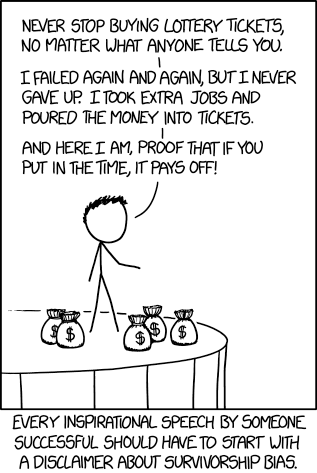
Source: XKCD (https://xkcd.com/1827/)
This is disturbingly relevant to those considering medicine, or those already in it. There are countless stories from people who have "made it", sharing their path to medicine and encouraging others to duplicate it. Some of these have merit. Many do not. The problem, as the XKCD comic notes, is the survivorship bias. There are many paths to and through medicine, but some are more risky than others. Those who achieve what could be considered to be a success naturally think they've got the inside track on how to become successful, because hey, it worked for them! I'm definitely guilty of this myself. Yet anecdotes are not data and what works for one person won't necessarily work for all people.
In medicine, the most common example of survivorship bias comes when considering attending medical school outside of Canada. It works for some people, people who are naturally pretty happy with the choice they made. Yet, we don't hear much from those who did not find success at a foreign medical school, who are understandably fairly shy about talking about their failures.
There are countless other situations where this holds true, however. There are many Canadian medical students who took some non-traditional paths to medicine. I did a second degree, for example. Others took comparatively difficult undergrads, such as engineering or art. Yet, while these paths work for some, I wouldn't call them reliable or optimal pathways to medicine.
I'd put CaRMS matching for Canadian medical students into this category as well. Successful candidates share their approach to matching to competitive programs, while those who didn't match, or matched low on their list generally don't share their often-very-similar stories.
The problem is that anecdotal data is often all students have to guide them. There isn't great data out there to say how to get into medical, how to land a good residency spot, or on the outcomes of studying medicine abroad. This is just my small reminder to treat every success story with a grain of salt, and to always, always, always have a reasonably reliable back-up plan in mind. Risk-taking is part of having a good career, as the only paths in life that come with guarantees are ones of mediocrity, yet gambling the future away in hopes of a payoff is never a recommended approach. Take the risks that still leave you standing if they don't work out - so that you can take the next chance that comes your way after that.
Tuesday, 7 February 2017
What's in the Scope of Medicine?
Physicians are privileged among healthcare practitioners in that medicine's scope, both functionally and legally, is essentially unbounded from a professional standpoint. While other healthcare professions are limited somewhat in what's considered their area of expertise, particularly from a legal perspective, physicians generally are not, with some obvious exceptions (dental work, for example).
Unfortunately, this also leaves unbounded the amount of information or expertise that could be considered worthwhile for a physician to learn. Any medical student past their first semester will have experienced this, sitting through more than a few lectures where some emphasized pieces of information appear to be relevant to the eventual practice of maybe 1% of the class only. Even as a future generalist, I can think of quite a bit that I've learned over the past 4 years that I will likely never have to use in clinical practice, even if some of my classmates will.
Physicians are also starting to explore areas outside of what is typically considered clinical medicine. For example, as the profession rightly acknowledges the high impact of social factors on health, medicine is slowly expanding to include, well, virtually anything. Everything from urban infrastructure, to primary education, to environmental regulations, to immigration, to energy policy touches on human health in significant ways. We have some teaching about these factors in medical school, but not overly in-depth, nor do we have time to touch on everything in society conceivably impacting health.
While I love learning about these "other" parts of healthcare outside of standard clinical medicine and finding ways to incorporate them into practice, it's unrealistic to expect me or anyone else to be masters of even a fraction of this material. This begs the question - what is essential for all physicians to know, and what is not? I don't believe we have answered this question particularly well and I believe it needs a good answer.
Physicians are fortunate to be able to push or around through the barriers that constrain other healthcare professionals from doing novel work outside their scope, because our scope is so ill-defined, and it leads to a lot of innovation within our healthcare system. That ability to innovate is worth preserving. The downside is that as we allow physicians to be just about anything these days, we've started structuring our medical education system to push physicians to be everything. This is neither realistic nor optimal.
At some point, we need to introduce more flexibility into our medical education to match the flexibility we expect from our practicing physicians. That means developing a core base of competency that is relevant to virtually everyone at that stage of training which is emphasized heavily, but then making much of what we currently teach non-mandatory. To compensate, more selective, elective, and extra-curricular education should be incorporated. Admittedly, this takes a degree of coordination medical schools and residency programs have not proven to be too adept at handling in the past. However, as medicine grows ever-wider, medical educators will have to start recognizing the limits of what can be taught and start seriously considering what should be taught, even if that means eliminating useful elements from what is currently part of the mandatory curriculum.
Unfortunately, this also leaves unbounded the amount of information or expertise that could be considered worthwhile for a physician to learn. Any medical student past their first semester will have experienced this, sitting through more than a few lectures where some emphasized pieces of information appear to be relevant to the eventual practice of maybe 1% of the class only. Even as a future generalist, I can think of quite a bit that I've learned over the past 4 years that I will likely never have to use in clinical practice, even if some of my classmates will.
Physicians are also starting to explore areas outside of what is typically considered clinical medicine. For example, as the profession rightly acknowledges the high impact of social factors on health, medicine is slowly expanding to include, well, virtually anything. Everything from urban infrastructure, to primary education, to environmental regulations, to immigration, to energy policy touches on human health in significant ways. We have some teaching about these factors in medical school, but not overly in-depth, nor do we have time to touch on everything in society conceivably impacting health.
While I love learning about these "other" parts of healthcare outside of standard clinical medicine and finding ways to incorporate them into practice, it's unrealistic to expect me or anyone else to be masters of even a fraction of this material. This begs the question - what is essential for all physicians to know, and what is not? I don't believe we have answered this question particularly well and I believe it needs a good answer.
Physicians are fortunate to be able to push or around through the barriers that constrain other healthcare professionals from doing novel work outside their scope, because our scope is so ill-defined, and it leads to a lot of innovation within our healthcare system. That ability to innovate is worth preserving. The downside is that as we allow physicians to be just about anything these days, we've started structuring our medical education system to push physicians to be everything. This is neither realistic nor optimal.
At some point, we need to introduce more flexibility into our medical education to match the flexibility we expect from our practicing physicians. That means developing a core base of competency that is relevant to virtually everyone at that stage of training which is emphasized heavily, but then making much of what we currently teach non-mandatory. To compensate, more selective, elective, and extra-curricular education should be incorporated. Admittedly, this takes a degree of coordination medical schools and residency programs have not proven to be too adept at handling in the past. However, as medicine grows ever-wider, medical educators will have to start recognizing the limits of what can be taught and start seriously considering what should be taught, even if that means eliminating useful elements from what is currently part of the mandatory curriculum.
Saturday, 24 December 2016
Combating Depression in Medical Trainees
Following-up quickly on the previous post, because identifying a problem is fairly meaningless if you can't do anything about it. I said in that post that there are no simple answers and that's definitely true. Equally important to note is that whatever responses to this problem I present (or that anyone else presents) will likely not have much of an evidence base behind them, as there isn't much good research on this problem in particular. Reasonable theories is about all we have at this stage. In any case, if I had some all-powerful influence over medical education policies, here's what I'd try.
1) Reduce Hours
Physicians work a lot. Residents work a lot more. Medical students work less, but still quite a bit. All work more than a standard 40-hour week. Heck, a 40-hour week ever is practically luxurious. A fair bit of unofficial work is also effectively required, whether that's administrative work, reading, teaching, or research. At the extreme ends, typically residents in high-intensity fields, 100+ hours per week is commonplace (out of a total of 168 hours in a week).
While many people avoid depression despite these long hours, it's hard to see how the rate of depression and depressive symptoms goes down without some relaxation in work hours. There are many ways to treat or prevent depression, but many of them take time, time which is not available when working 100+ hours per week. Basic self-care suffers under such schedules, let alone the extra care needed to maintain or improve mental health. The correlation between resident work hours and sleep is pretty clear, for example - more hours at the hospital means less sleep overall.
Simple work hour limits have been put in place in the US to some effect, but with significant limitations. Part of the problem with straight work hour limits is that programs still need the same amount of work done by the same number of people, just with fewer hours. So, residency programs find inventive ways to get the same work done by the same number of people through creative (often undesirable) scheduling, increasing workloads during worked hours, or straight-up lying about hours worked (particularly common in surgical specialties in the US).
Another concern with reduced working hours is that it may require extension in the number of years of residency in order to maintain the number of total hours worked and allow residents to gain the necessary experience to become competent. A certain amount of exposure to a given pathology or procedure is necessary to be able to work independently, of course. The argument here is that if residency is going to be terrible, it might as well be as compact as possible to allow physicians to move onto independent practice.
All things considered, I don't believe reducing work hours alone will be particularly effective in reducing depression among residents, but I do believe it is a necessary component to any solution. I believe it needs to come in conjunction with efforts to make residency training more effective in terms of educational outcomes, and more efficient in terms of workload completion. I see substantial room for improvement on both these fronts.
2) Orientation and Role Definition
One thing that's always struck me about medicine is how little orientation people get to their surroundings. Physicians-in-training are thrown into situations without any idea as to what their responsibilities are or how to carry out those responsibilities. I had a better orientation when I worked at McDonald's in high school than I have at any point during my medical training.
The disjointed nature of medical training does not help this process. During my clerkship, I had one rotation that lasted 6 weeks, one rotation that lasted 4 weeks, and one rotation that lasted 3 weeks. Everything else lasted for 2 weeks or less. By the end of a 2 week rotation, I would usually have a decent idea as to what I was supposed to be doing and how to start doing it somewhat effectively, but by that point, it was onto the next rotation and the whole process started over again.
Having a clear role, and having that role understood by those around you (especially superiors) is an important factor in overall job satisfaction. I see little reason to think this doesn't apply equally to physicians-in-training.
Ideally this would be accomplished with dedicated time for orientation combined with a degree of standardization of roles for learners between all rotations, but that may be overly ambitious. An easier change to implement could be simply having instructions for trainees put down in writing and communicated to both learners and instructors. This would not take much effort to accomplish, yet I found this simple document was not present for most of my rotations.
3) Allow Greater Flexibility in Education
Working hard, long hours sucks. Working hard, long hours you have some say over sucks a whole lot less. People who have control over their schedules tend to have much higher satisfaction with their work and their lives.
Realistically, students and residents are never going to have complete autonomy over their schedules. Yet, they could have a lot more control than they currently have. When talking about long hours, while many would prefer intensive, shorter residencies, some may want longer residencies with more favourable hours - yet this is an option only at a small handful of residency programs (usually Family Medicine programs).
Likewise, there are a lot of aspects to medical training which are mandatory across-the-board without having across-the-board value. My school has 12 weeks of required surgical training, yet the majority of students will never step foot in an OR after finishing residency. Likewise, of those who are going to be in the OR, do they need the full 6 weeks of training in both Family Medicine and another 6 weeks in Psychiatry? Would half the training in each make that much of a difference in overall competence once training is completed? Could that time be better spent if freed up for more electives or selectives? Some training in surgery, psychiatry, and family medicine seems necessary for all physicians, but additional exposure comes with diminishing returns.
Similarly, having some control over productivity within the day-to-day schedule may be beneficial. Pretty much every residency program has academic half-days and function well enough with residents missing for a period of time to attend mandatory lectures. Would it be possible to give residents a half-day to set their own schedules, whether that's working on research, attending specific clinics, or gaining more experience with useful procedures.
4) Just Treat Each Other Better!
Physicians aren't terribly nice to each other. I believe we're largely past the times where physicians used to be outright cruel to each other, but kindness is still often lacking. Encouraging words come far less frequently than they could or should. Gratitude between physicians is less frequent and less genuine than it could be ("Thank you for sending us this consult" isn't really a statement of appreciation as much as a nicety). When someone is sick, or needs to go pick up their kid from daycare, or just struggling to keep up, would it be that terrible to send them home when there's enough people around to do the work at hand - even if it means a little extra effort on the part of those left? All my other jobs managed these situations well enough, including those in health care.
5) Wellness Programs
In general, I'm not a fan of wellness programs currently being rolled out at many medical education institutions. They feel like trying to put a small bandage on a wound after waving around a knife that inflicted the wound in the first place. It's better than nothing, but not nearly adequate and doesn't address why a bandage was necessary in the first place. I find them to be inconvenient for most people and maintains the onus on trainees to help themselves. They often provide resources that are already available in the community in one form or another. As a result, they are often most utilized by those already motivated to improve their situations and willing to make sacrifices to do so - individuals who might have been able to pull themselves up even without a dedicated wellness program.
Still, some of the typical elements of wellness programs have some good evidence behind them. Meditation, yoga, and tai chi do have some benefits to mental health - as does exercise and mindfulness in general. Opportunities to talk through problems, or to reflect on them individually, can both be beneficial. Being able to reframe problems as opportunities, to develop a problem-solving attitude, can be quite useful in forming resilience to challenges. While I dislike the emphasis on wellness programs, they can be part of the solution for a subset of trainees.
To wrap things up, we're never going to eliminate depression or other forms of mental health problems from medicine. There will always be some medical students, residents, and staff struggling with low mood. However, it's clear that the rates of depression are higher than baseline, well higher than they could be given the resources the profession has at its disposal, and certainly higher than is ideal for high-quality patient care. There's a lot we could be doing to minimize this problem.
1) Reduce Hours
Physicians work a lot. Residents work a lot more. Medical students work less, but still quite a bit. All work more than a standard 40-hour week. Heck, a 40-hour week ever is practically luxurious. A fair bit of unofficial work is also effectively required, whether that's administrative work, reading, teaching, or research. At the extreme ends, typically residents in high-intensity fields, 100+ hours per week is commonplace (out of a total of 168 hours in a week).
While many people avoid depression despite these long hours, it's hard to see how the rate of depression and depressive symptoms goes down without some relaxation in work hours. There are many ways to treat or prevent depression, but many of them take time, time which is not available when working 100+ hours per week. Basic self-care suffers under such schedules, let alone the extra care needed to maintain or improve mental health. The correlation between resident work hours and sleep is pretty clear, for example - more hours at the hospital means less sleep overall.
Simple work hour limits have been put in place in the US to some effect, but with significant limitations. Part of the problem with straight work hour limits is that programs still need the same amount of work done by the same number of people, just with fewer hours. So, residency programs find inventive ways to get the same work done by the same number of people through creative (often undesirable) scheduling, increasing workloads during worked hours, or straight-up lying about hours worked (particularly common in surgical specialties in the US).
Another concern with reduced working hours is that it may require extension in the number of years of residency in order to maintain the number of total hours worked and allow residents to gain the necessary experience to become competent. A certain amount of exposure to a given pathology or procedure is necessary to be able to work independently, of course. The argument here is that if residency is going to be terrible, it might as well be as compact as possible to allow physicians to move onto independent practice.
All things considered, I don't believe reducing work hours alone will be particularly effective in reducing depression among residents, but I do believe it is a necessary component to any solution. I believe it needs to come in conjunction with efforts to make residency training more effective in terms of educational outcomes, and more efficient in terms of workload completion. I see substantial room for improvement on both these fronts.
2) Orientation and Role Definition
One thing that's always struck me about medicine is how little orientation people get to their surroundings. Physicians-in-training are thrown into situations without any idea as to what their responsibilities are or how to carry out those responsibilities. I had a better orientation when I worked at McDonald's in high school than I have at any point during my medical training.
The disjointed nature of medical training does not help this process. During my clerkship, I had one rotation that lasted 6 weeks, one rotation that lasted 4 weeks, and one rotation that lasted 3 weeks. Everything else lasted for 2 weeks or less. By the end of a 2 week rotation, I would usually have a decent idea as to what I was supposed to be doing and how to start doing it somewhat effectively, but by that point, it was onto the next rotation and the whole process started over again.
Having a clear role, and having that role understood by those around you (especially superiors) is an important factor in overall job satisfaction. I see little reason to think this doesn't apply equally to physicians-in-training.
Ideally this would be accomplished with dedicated time for orientation combined with a degree of standardization of roles for learners between all rotations, but that may be overly ambitious. An easier change to implement could be simply having instructions for trainees put down in writing and communicated to both learners and instructors. This would not take much effort to accomplish, yet I found this simple document was not present for most of my rotations.
3) Allow Greater Flexibility in Education
Working hard, long hours sucks. Working hard, long hours you have some say over sucks a whole lot less. People who have control over their schedules tend to have much higher satisfaction with their work and their lives.
Realistically, students and residents are never going to have complete autonomy over their schedules. Yet, they could have a lot more control than they currently have. When talking about long hours, while many would prefer intensive, shorter residencies, some may want longer residencies with more favourable hours - yet this is an option only at a small handful of residency programs (usually Family Medicine programs).
Likewise, there are a lot of aspects to medical training which are mandatory across-the-board without having across-the-board value. My school has 12 weeks of required surgical training, yet the majority of students will never step foot in an OR after finishing residency. Likewise, of those who are going to be in the OR, do they need the full 6 weeks of training in both Family Medicine and another 6 weeks in Psychiatry? Would half the training in each make that much of a difference in overall competence once training is completed? Could that time be better spent if freed up for more electives or selectives? Some training in surgery, psychiatry, and family medicine seems necessary for all physicians, but additional exposure comes with diminishing returns.
Similarly, having some control over productivity within the day-to-day schedule may be beneficial. Pretty much every residency program has academic half-days and function well enough with residents missing for a period of time to attend mandatory lectures. Would it be possible to give residents a half-day to set their own schedules, whether that's working on research, attending specific clinics, or gaining more experience with useful procedures.
4) Just Treat Each Other Better!
Physicians aren't terribly nice to each other. I believe we're largely past the times where physicians used to be outright cruel to each other, but kindness is still often lacking. Encouraging words come far less frequently than they could or should. Gratitude between physicians is less frequent and less genuine than it could be ("Thank you for sending us this consult" isn't really a statement of appreciation as much as a nicety). When someone is sick, or needs to go pick up their kid from daycare, or just struggling to keep up, would it be that terrible to send them home when there's enough people around to do the work at hand - even if it means a little extra effort on the part of those left? All my other jobs managed these situations well enough, including those in health care.
5) Wellness Programs
In general, I'm not a fan of wellness programs currently being rolled out at many medical education institutions. They feel like trying to put a small bandage on a wound after waving around a knife that inflicted the wound in the first place. It's better than nothing, but not nearly adequate and doesn't address why a bandage was necessary in the first place. I find them to be inconvenient for most people and maintains the onus on trainees to help themselves. They often provide resources that are already available in the community in one form or another. As a result, they are often most utilized by those already motivated to improve their situations and willing to make sacrifices to do so - individuals who might have been able to pull themselves up even without a dedicated wellness program.
Still, some of the typical elements of wellness programs have some good evidence behind them. Meditation, yoga, and tai chi do have some benefits to mental health - as does exercise and mindfulness in general. Opportunities to talk through problems, or to reflect on them individually, can both be beneficial. Being able to reframe problems as opportunities, to develop a problem-solving attitude, can be quite useful in forming resilience to challenges. While I dislike the emphasis on wellness programs, they can be part of the solution for a subset of trainees.
To wrap things up, we're never going to eliminate depression or other forms of mental health problems from medicine. There will always be some medical students, residents, and staff struggling with low mood. However, it's clear that the rates of depression are higher than baseline, well higher than they could be given the resources the profession has at its disposal, and certainly higher than is ideal for high-quality patient care. There's a lot we could be doing to minimize this problem.
Tuesday, 15 November 2016
So, About Last Tuesday...
I'd feel almost neglectful if I didn't touch on the US election last week. This blog is primarily about medicine and healthcare, so my intention was to touch on the numerous effects a Trump presidency is likely to have on the health of people in America as well as those abroad. However, since starting this piece, both major media outlets and more healthcare-focused sites have provided analysis of this with various degrees of depth, and I'm not sure I have much to add. Fortunately, the effects are fairly easy to sum up without losing too much with the brevity - a large number of people, mostly poor or sick people, will lose their health insurance or will end up with less-comprehensive coverage.
Of course, health effects will depend on exactly what policies Trump choose to enact, whether unilaterally through executive action, or through legislation by working with Congress, so it's hard to say exactly what will happen. Nevertheless, the proposals presented thus far all lead to that somewhat over-simplistic conclusion above according to multiple independent analyses.
It's a striking reminder that health depends on so much more than medicine. The sum of medical knowledge and ability in the US is constantly increasing, but the health of its citizens is likely to worsen if Trump proceeds as promised during his campaign. Keeping engaged in the political process and involved in advocacy roles are both important ways for physicians to influence the wider society that has far greater effects on patient health than most physicians' direct actions.
Like many disappointed by Trump's victory, I take this result as a spur to action. No, I'm not American, but it's a reminder that undesirable outcomes are often the result of complacency and that to see sustained progress, sustained effort is required. While I do use this blog as a way to express my viewpoints openly and honestly, I would like to make a more concerted effort to be directly involved in how the world is run around me. That said, as we see protests spring up across America, I'm equally reminded that hate is not the answer to hate. Most of the protests are peaceful, but some are not, and violence cannot be the answer even when other viable options are available.
Lastly, I'm reminded that effective advocacy should be one of the final steps to enacting change, not one of the first. Before pushing for what we think is right, it's vitally important that we take the time to determine what right is. Too often, advocates assume their positions are correct without ever challenging their own viewpoints, and good intentions are no substitute for a considered, informed opinion. Reading, listening, and learning are essential before - and after - speaking out. That includes
paying attention to those viewpoints opposed to yours. Those opposing views don't need to be accepted, but they should at least be understood. Furthermore, when asking the world to change, we first should consider how we can change ourselves. No one's perfect and that's an unrealistic goal, but there is always something we can do to change our actions and behaviours to do further our own priorities for the world.
I do a lot of my advocacy through this blog and other online postings. It's not a particularly effective approach - those who come to the read the blog are typically sympathetic to my viewpoints already, so I'm largely preaching to the choir. So, I feel the need to take a few more direct steps. My first is by starting some regular charitable contributions to causes I care about, putting my (currently limited) money where my mouth is. My goal has always been to give a significant potion of my income to these or similar charities, so despite my growing debt, I might as well start now, as I'm finally on the verge of having a real income. While I've always been involved with school projects that I feel are meaningful, I'm going to try to spend my last year and hopefully my residency as well, with more direct involvement in the curricular side of medical education. Lastly, I'm looking into ways to be involved in the political process. I'm not sure what form that will take, as I'm not particularly partisan and not sure how I feel about joining any political party, but it's time I explore my options. Staying on the relative sidelines, where writing and voting are my only methods of influencing policy, just doesn't feel like enough at this stage.
Of course, health effects will depend on exactly what policies Trump choose to enact, whether unilaterally through executive action, or through legislation by working with Congress, so it's hard to say exactly what will happen. Nevertheless, the proposals presented thus far all lead to that somewhat over-simplistic conclusion above according to multiple independent analyses.
It's a striking reminder that health depends on so much more than medicine. The sum of medical knowledge and ability in the US is constantly increasing, but the health of its citizens is likely to worsen if Trump proceeds as promised during his campaign. Keeping engaged in the political process and involved in advocacy roles are both important ways for physicians to influence the wider society that has far greater effects on patient health than most physicians' direct actions.
Like many disappointed by Trump's victory, I take this result as a spur to action. No, I'm not American, but it's a reminder that undesirable outcomes are often the result of complacency and that to see sustained progress, sustained effort is required. While I do use this blog as a way to express my viewpoints openly and honestly, I would like to make a more concerted effort to be directly involved in how the world is run around me. That said, as we see protests spring up across America, I'm equally reminded that hate is not the answer to hate. Most of the protests are peaceful, but some are not, and violence cannot be the answer even when other viable options are available.
Lastly, I'm reminded that effective advocacy should be one of the final steps to enacting change, not one of the first. Before pushing for what we think is right, it's vitally important that we take the time to determine what right is. Too often, advocates assume their positions are correct without ever challenging their own viewpoints, and good intentions are no substitute for a considered, informed opinion. Reading, listening, and learning are essential before - and after - speaking out. That includes
paying attention to those viewpoints opposed to yours. Those opposing views don't need to be accepted, but they should at least be understood. Furthermore, when asking the world to change, we first should consider how we can change ourselves. No one's perfect and that's an unrealistic goal, but there is always something we can do to change our actions and behaviours to do further our own priorities for the world.
I do a lot of my advocacy through this blog and other online postings. It's not a particularly effective approach - those who come to the read the blog are typically sympathetic to my viewpoints already, so I'm largely preaching to the choir. So, I feel the need to take a few more direct steps. My first is by starting some regular charitable contributions to causes I care about, putting my (currently limited) money where my mouth is. My goal has always been to give a significant potion of my income to these or similar charities, so despite my growing debt, I might as well start now, as I'm finally on the verge of having a real income. While I've always been involved with school projects that I feel are meaningful, I'm going to try to spend my last year and hopefully my residency as well, with more direct involvement in the curricular side of medical education. Lastly, I'm looking into ways to be involved in the political process. I'm not sure what form that will take, as I'm not particularly partisan and not sure how I feel about joining any political party, but it's time I explore my options. Staying on the relative sidelines, where writing and voting are my only methods of influencing policy, just doesn't feel like enough at this stage.
Tuesday, 25 October 2016
Problem-Based Learning - A Follow-Up
I'm of the viewpoint that you shouldn't criticize the actions of others without having a reasonable alternative to offer. I'm not a fan of traditional lecture-based medical education, and just wrote a post against one of the more popular alternatives in Problem-Based Learning (PBL) curriculums, so I should probably provide some sort of third option.
Lectures, PBL, any other approach in education is simply a tool to transmit information. Like any tool, they can be used effectively or ineffectively. Hammers work great on nails, not so much on screws. Lectures are amazing at conveying large amounts of information quickly to large groups of people. However, unless an instructor is particularly capable, lectures are terrible for information retention. PBL is great for information retention, but terrible for information transmission. Used in conjunction, these approaches can maximize efficiency in education. Introductory information is conveyed via lectures in bulk, then emphasized and expanded upon with appropriate problems.
Many schools employ some version of this combined approach, but not necessarily in a well-constructed manner. Sometimes one technique is relied upon too heavily. Sometimes the timing or coordination is problematic, such as providing a PBL task before a lecture, or so far after it that retention from the lecture is minimal. Deliberately using both techniques together, as two parts of a whole, is preferable.
In reality though, the tools themselves are flexible and can be adapted to account for their weakness. Lectures can be interactive and entertaining, maximizing retention. PBL can provide concise supporting resources, or have knowledgeable instructors available to provide context and guidance. Yet achieving these adaptations is easier said than done. Strong lecturers are surprisingly rare. Having adequate numbers of instructors for PBL for an entire curriculum is expensive. As such, combinations of approaches may permit less-than-ideal versions of these tools to be sufficiently effective given basic resource constraints.
If I were designing an educational approach from scratch, my emphasis would be on the basic points of educational psychology that too often get neglected - scaffolding, context, and repetition. Clinical education is so effective because it naturally includes all these elements. Pre-clinical education is often so ineffective because it fails to incorporate them. Repetition in particular is sorely lacking.
My preferred structure for medical education would be based around repetition. If a piece of information isn't conveyed at least three times within the span of a month or so, to me, it's not even worth teaching, at least not at such an early stage as during pre-clerkship years. I would like to see another tool, one which has a good evidence base behind it, used more frequently - formative assessments. Formative assessments are wonderful because they eliminate the pressure for short-term learning seen in summative assessments, while providing an opportunity to identify gaps in knowledge.
So here's my ideal set-up: in the first week, lectures, small group discussions, or readings would be given on a set of associated information. This transmits the information. The second week, a formative assessment is given testing all the transmitted information. This assessment is taken up with students to identify class-wide and personal gaps in knowledge. The third week, an applied, context-heavy session is held. This could be PBL, Team-Based Learning, physical skills instruction, anatomy lab, or really anything that requires some application of the knowledge outside a classroom setting. Ideally, this would adapted to the weak points in class' knowledge based on the formative assessment. Four-to-six weeks later, a summative assessment is given to test the students' knowledge, forming the basis of the students' marks. Even though this is a graded test, the results of the test should be given to the students to identify any remaining deficiencies in knowledge. Evaluations are necessary, but they're also one of the best ways to learn, and I've never understood why schools place such a high priority on keeping test answers secret. Yes, I know they want to keep future classes from just studying the questions on the test, but it's a poor excuse. Either schools are failing to ask a wide enough variety of questions on their tests (question bank is to small for the amount of material provided or they're recycling a limited number of idiosyncratic questions), or all the pertinent information is in those questions they're asking and in that case, who cares how students learn that information - that means they're getting all the necessary data!
The main weakness to my approach is that it's a bit more time-intensive for each fact that gets presented. You can't give nearly the same number of lectures if you're losing a day or two each week to formative assessments or application tasks like PBL. I strongly believe this to be a worthwhile trade-off. While less information is provided to students, more should be retained. More importantly, what information is retained should be more consistent student-to-student. Consistency matters when setting expectations for subsequent steps, such as in clerkship. I found it baffling that I could know nothing about a part medicine that I learned about in pre-clerkship and no one cared - what was the point of those first two years if I could start right back at the beginning without consequence? What I did remember of course came in handy, but what I retained from pre-clerkship and what my colleagues retained from pre-clerkship was at times shockingly different. Clinical instructors have to set the bar very low when there's such variability in learner knowledge.
I'm starting to ramble, so I'll try to wrap this up. In medicine, clinical education will always be the most critical aspect. I've argued before that we should substantially reduce pre-clerkship education, or even scrap it entirely. However, realizing that clinical educational opportunities are limited and that having some base knowledge before seeing patients helps protect both students and patients, I doubt we'll ever eliminate pre-clerkship education. So, if it must exist, I think it could use a revamp, to become more efficient, more effective, and for its results to be more consistent. It doesn't take more money, or more time, or fancy educational innovations. It just requires some variety in instruction techniques and a focus on applying the basics of educational theory thoroughly.
Lectures, PBL, any other approach in education is simply a tool to transmit information. Like any tool, they can be used effectively or ineffectively. Hammers work great on nails, not so much on screws. Lectures are amazing at conveying large amounts of information quickly to large groups of people. However, unless an instructor is particularly capable, lectures are terrible for information retention. PBL is great for information retention, but terrible for information transmission. Used in conjunction, these approaches can maximize efficiency in education. Introductory information is conveyed via lectures in bulk, then emphasized and expanded upon with appropriate problems.
Many schools employ some version of this combined approach, but not necessarily in a well-constructed manner. Sometimes one technique is relied upon too heavily. Sometimes the timing or coordination is problematic, such as providing a PBL task before a lecture, or so far after it that retention from the lecture is minimal. Deliberately using both techniques together, as two parts of a whole, is preferable.
In reality though, the tools themselves are flexible and can be adapted to account for their weakness. Lectures can be interactive and entertaining, maximizing retention. PBL can provide concise supporting resources, or have knowledgeable instructors available to provide context and guidance. Yet achieving these adaptations is easier said than done. Strong lecturers are surprisingly rare. Having adequate numbers of instructors for PBL for an entire curriculum is expensive. As such, combinations of approaches may permit less-than-ideal versions of these tools to be sufficiently effective given basic resource constraints.
If I were designing an educational approach from scratch, my emphasis would be on the basic points of educational psychology that too often get neglected - scaffolding, context, and repetition. Clinical education is so effective because it naturally includes all these elements. Pre-clinical education is often so ineffective because it fails to incorporate them. Repetition in particular is sorely lacking.
My preferred structure for medical education would be based around repetition. If a piece of information isn't conveyed at least three times within the span of a month or so, to me, it's not even worth teaching, at least not at such an early stage as during pre-clerkship years. I would like to see another tool, one which has a good evidence base behind it, used more frequently - formative assessments. Formative assessments are wonderful because they eliminate the pressure for short-term learning seen in summative assessments, while providing an opportunity to identify gaps in knowledge.
So here's my ideal set-up: in the first week, lectures, small group discussions, or readings would be given on a set of associated information. This transmits the information. The second week, a formative assessment is given testing all the transmitted information. This assessment is taken up with students to identify class-wide and personal gaps in knowledge. The third week, an applied, context-heavy session is held. This could be PBL, Team-Based Learning, physical skills instruction, anatomy lab, or really anything that requires some application of the knowledge outside a classroom setting. Ideally, this would adapted to the weak points in class' knowledge based on the formative assessment. Four-to-six weeks later, a summative assessment is given to test the students' knowledge, forming the basis of the students' marks. Even though this is a graded test, the results of the test should be given to the students to identify any remaining deficiencies in knowledge. Evaluations are necessary, but they're also one of the best ways to learn, and I've never understood why schools place such a high priority on keeping test answers secret. Yes, I know they want to keep future classes from just studying the questions on the test, but it's a poor excuse. Either schools are failing to ask a wide enough variety of questions on their tests (question bank is to small for the amount of material provided or they're recycling a limited number of idiosyncratic questions), or all the pertinent information is in those questions they're asking and in that case, who cares how students learn that information - that means they're getting all the necessary data!
The main weakness to my approach is that it's a bit more time-intensive for each fact that gets presented. You can't give nearly the same number of lectures if you're losing a day or two each week to formative assessments or application tasks like PBL. I strongly believe this to be a worthwhile trade-off. While less information is provided to students, more should be retained. More importantly, what information is retained should be more consistent student-to-student. Consistency matters when setting expectations for subsequent steps, such as in clerkship. I found it baffling that I could know nothing about a part medicine that I learned about in pre-clerkship and no one cared - what was the point of those first two years if I could start right back at the beginning without consequence? What I did remember of course came in handy, but what I retained from pre-clerkship and what my colleagues retained from pre-clerkship was at times shockingly different. Clinical instructors have to set the bar very low when there's such variability in learner knowledge.
I'm starting to ramble, so I'll try to wrap this up. In medicine, clinical education will always be the most critical aspect. I've argued before that we should substantially reduce pre-clerkship education, or even scrap it entirely. However, realizing that clinical educational opportunities are limited and that having some base knowledge before seeing patients helps protect both students and patients, I doubt we'll ever eliminate pre-clerkship education. So, if it must exist, I think it could use a revamp, to become more efficient, more effective, and for its results to be more consistent. It doesn't take more money, or more time, or fancy educational innovations. It just requires some variety in instruction techniques and a focus on applying the basics of educational theory thoroughly.
Saturday, 22 October 2016
Problem-Based Learning
One of the new trends in medical education, particularly in the US, is Problem-Based Learning or PBL. PBL posits that letting students explore topics openly, with goals and guidance rather than tasks and obligations, will lead to greater investment in learning by students, as well as overall better retention of knowledge. Extending on this idea, PBL often involves students working in teams - Team-Based Learning or TBL - to allow students to share knowledge more freely and to work collaboratively towards a solution.
In theory, PBL addresses a lot of the objections I have to the current "standard" approach in medical education, particularly in pre-clerkship. I find the lecture-heavy, test-based format I went through to be rather inefficient and puts students in a fine position to burn out or put in a token effort. Yet, I'm very skeptical of PBL, particularly TBL, in the way many schools seem to want to use it.
Central to my concerns with PBL is that to solve a problem, you first need the tools and knowledge to do so. Giving students the freedom to choose an approach, or putting them in groups to work together, does little to overcome any gaps in necessary knowledge students inevitably have when training to become a physician. PBL proponents will argue that having students explore to find that background knowledge helps retention - and undoubtedly it does - but it's also very inefficient unless students know exactly where to look for that information. For example, it's very important for students to know the first-line treatment for simple UTIs. It's basic knowledge anyone who's finished clerkship should be able to pass along. Yet, if you were to search for that information, you'll quickly get about a half-dozen different answers, all of which are partially correct, but picking out the standard conventional answer is impossible without being given some actual instruction by a knowledgeable person. A naive learner simply won't have the context necessary to discriminate between imprecise recommendations available. The freedom to explore an answer - or the benefit of collective thought - simply doesn't contribute in the way guided instruction would.
Once all the necessary background information has been learned or provided, PBL works great at putting it all together. Moreover, putting all that knowledge together can help with retention of those facts. TBL can further enhance this by letting students fill in each others gaps in knowledge, since no student gets everything right 100% of the time - even the best students forget something.
Unfortunately, the goal of pre-clerkship is largely to give students that background information. Putting it together is left for clerkship, which essentially functions like a natural form of PBL. Clerkship has the additional advantage of authenticity, an often-overlooked trait when trying to motivate students to work. For all its promise of enhanced student engagement, PBL suffers from much the same drawback as traditional instruction - goals are set by the program, not by the student. PBL becomes just a different hurdle to jump over to move onto the next step. The motivation to do well remains extrinsic, even as engagement increases. In clerkship, the presence of an actual patient to empathize with - and the fear of disappointing preceptors invested in their patients well-being - provides some intrinsic motivation.
PBL and TBL can have an important role in education, particularly medical education, but their use needs to be tailored to their strengths. These techniques should be used to solidify knowledge already learned, not to teach new information. Most importantly - and proponents of PBL are quick to advocate this - instructors should be readily available to provide context and direction, as both PBL and TBL can quickly become troublesome if students' thoughts veer away from the correct path. As much as possible, PBL should be used where students already have motivation to learn, should be evaluated in a formative manner, and ideally the topic should involve some choice from students. PBL is a great tool, but it's not a panacea - it should be used where it's appropriate, and discarded where not. My experiences with PBL and TBL thus far have made me worried that educators might not understand where these tools are best employed.
In theory, PBL addresses a lot of the objections I have to the current "standard" approach in medical education, particularly in pre-clerkship. I find the lecture-heavy, test-based format I went through to be rather inefficient and puts students in a fine position to burn out or put in a token effort. Yet, I'm very skeptical of PBL, particularly TBL, in the way many schools seem to want to use it.
Central to my concerns with PBL is that to solve a problem, you first need the tools and knowledge to do so. Giving students the freedom to choose an approach, or putting them in groups to work together, does little to overcome any gaps in necessary knowledge students inevitably have when training to become a physician. PBL proponents will argue that having students explore to find that background knowledge helps retention - and undoubtedly it does - but it's also very inefficient unless students know exactly where to look for that information. For example, it's very important for students to know the first-line treatment for simple UTIs. It's basic knowledge anyone who's finished clerkship should be able to pass along. Yet, if you were to search for that information, you'll quickly get about a half-dozen different answers, all of which are partially correct, but picking out the standard conventional answer is impossible without being given some actual instruction by a knowledgeable person. A naive learner simply won't have the context necessary to discriminate between imprecise recommendations available. The freedom to explore an answer - or the benefit of collective thought - simply doesn't contribute in the way guided instruction would.
Once all the necessary background information has been learned or provided, PBL works great at putting it all together. Moreover, putting all that knowledge together can help with retention of those facts. TBL can further enhance this by letting students fill in each others gaps in knowledge, since no student gets everything right 100% of the time - even the best students forget something.
Unfortunately, the goal of pre-clerkship is largely to give students that background information. Putting it together is left for clerkship, which essentially functions like a natural form of PBL. Clerkship has the additional advantage of authenticity, an often-overlooked trait when trying to motivate students to work. For all its promise of enhanced student engagement, PBL suffers from much the same drawback as traditional instruction - goals are set by the program, not by the student. PBL becomes just a different hurdle to jump over to move onto the next step. The motivation to do well remains extrinsic, even as engagement increases. In clerkship, the presence of an actual patient to empathize with - and the fear of disappointing preceptors invested in their patients well-being - provides some intrinsic motivation.
PBL and TBL can have an important role in education, particularly medical education, but their use needs to be tailored to their strengths. These techniques should be used to solidify knowledge already learned, not to teach new information. Most importantly - and proponents of PBL are quick to advocate this - instructors should be readily available to provide context and direction, as both PBL and TBL can quickly become troublesome if students' thoughts veer away from the correct path. As much as possible, PBL should be used where students already have motivation to learn, should be evaluated in a formative manner, and ideally the topic should involve some choice from students. PBL is a great tool, but it's not a panacea - it should be used where it's appropriate, and discarded where not. My experiences with PBL and TBL thus far have made me worried that educators might not understand where these tools are best employed.
Tuesday, 18 October 2016
Familiar Faces
Unlike most elective students, I'm doing a good number of my electives at my home school.
Part of this was by design - as a student applying primarily to Family Medicine, I don't need to do nearly as many electives in one field, so I've got some extra elective time to spend on learning opportunities, on rotations I haven't experienced yet first-hand. Those can be done anywhere, so might as well do them in a familiar setting where I don't have to pay for travel or accommodations. Plus, I can spend more time with my partner and dog at home!
Part of this was definitely not by design - I had some electives at other schools fall through last-minute after months of waiting. Just a reminder that despite the new electives portal in Canada that is supposed make electives more accessible and to eliminate the need for elective-hoarding, there's still a major incentive to gather up as many electives as possible, dropping any excess ones as you go.
One unexpected advantage of this arrangement, however, is getting to see some patients I saw previously on my third year rotations. Seeing a familiar name, or stumbling across a prior dictation with your own name on it is pretty exciting! (Side note - dictation services do a pretty good job. Recently read a note I dictating very early in clerkship and superficially, it looks amazing! When I actually read the content, it's fairly disorganized and rambling. It does its job, but I feel I can do so much better at this stage and it only looks half-decent because the dictating service my hospital uses made it look that good).
This is not necessarily a common experience in medical school. We get shifted from service to service regularly enough that any continuity within these services is pretty short-term. Seeing a patient after 2 months isn't quite the same as checking in on them over a year later, but this longitudinal care is a core part of being a physician. Even as just a reminder of the growth we go through as medical students, I'm appreciating the experience. I know some schools, particularly satellite campuses, have been working with clerkship models that build these sorts of longitudinal experiences into their structure, and US schools having been piloting studies on longitudinal clerkship for years. From speaking to some people in longitudinal medical education programs, I've been given the sense that these set-ups are better in theory than in action, but there is some interesting research on the subject. Given my recent experiences, I would love to see effective longitudinal care fit more cleanly and reliably into undergraduate medical education.
Part of this was by design - as a student applying primarily to Family Medicine, I don't need to do nearly as many electives in one field, so I've got some extra elective time to spend on learning opportunities, on rotations I haven't experienced yet first-hand. Those can be done anywhere, so might as well do them in a familiar setting where I don't have to pay for travel or accommodations. Plus, I can spend more time with my partner and dog at home!
Part of this was definitely not by design - I had some electives at other schools fall through last-minute after months of waiting. Just a reminder that despite the new electives portal in Canada that is supposed make electives more accessible and to eliminate the need for elective-hoarding, there's still a major incentive to gather up as many electives as possible, dropping any excess ones as you go.
One unexpected advantage of this arrangement, however, is getting to see some patients I saw previously on my third year rotations. Seeing a familiar name, or stumbling across a prior dictation with your own name on it is pretty exciting! (Side note - dictation services do a pretty good job. Recently read a note I dictating very early in clerkship and superficially, it looks amazing! When I actually read the content, it's fairly disorganized and rambling. It does its job, but I feel I can do so much better at this stage and it only looks half-decent because the dictating service my hospital uses made it look that good).
This is not necessarily a common experience in medical school. We get shifted from service to service regularly enough that any continuity within these services is pretty short-term. Seeing a patient after 2 months isn't quite the same as checking in on them over a year later, but this longitudinal care is a core part of being a physician. Even as just a reminder of the growth we go through as medical students, I'm appreciating the experience. I know some schools, particularly satellite campuses, have been working with clerkship models that build these sorts of longitudinal experiences into their structure, and US schools having been piloting studies on longitudinal clerkship for years. From speaking to some people in longitudinal medical education programs, I've been given the sense that these set-ups are better in theory than in action, but there is some interesting research on the subject. Given my recent experiences, I would love to see effective longitudinal care fit more cleanly and reliably into undergraduate medical education.
Monday, 26 September 2016
Communication Skills
When it comes to being a clerk, I consider myself pretty average. I keep up with my readings, know my patients pretty well, and generally put in a good effort into my clinical duties. However, I'm far from exceptional in any of these domains. Where I do consider myself a bit stronger is when it comes to communicating with patients and their families. I have plenty to learn and perfect on that front, but I'll put myself a bit ahead of the pack on that front.
A major component of this is learning how to say "no" without it seeming like an exercise in power. The phrase I hear some doctors rely on which irks me so much because of the problems it causes patients (and other providers) is "I won't". A patient makes a request and the physician says "I won't do that". There is typically a good reason for the refusal and the physician either can't or shouldn't fulfill the request in the first place. Even with an explanation of the refusal, "I won't" sticks in patients minds, because they see the physician as being capable of helping, but actively choosing not to. It hurts a lot of patient-physician relationships. I like using "I can't" as much as possible, provided it's appropriate. Fortunately, most "I won't"s can be framed as "I can't"s. Patients are still disappointed by refusals presented this way, but I find they're less disappointed in me as a care provider, and that helps to maintain the therapeutic relationship a bit better. Physicians and patients have a natural imbalance, which patients certainly feel. By emphasizing your own lack of ability to change things with phrases like "I can't", it can help to lessen the feeling of that imbalance, and to make it clear that even if you aren't able to solve all their problems, you're still trying to do what you can.
4) Ensure you're on the same page
Even when a physician is an amazing communicator, patients don't always understand the full plan. Medicine is vast and confusing, even to the initiated. Human memory is flawed in healthy people and gets worse when we're sick or stressed. Letting patients know what's coming is only effective if they absorb what was said and remember it.
Some easy strategies can help retention. I frequently try to repeat whatever plan we agree on in a concise way at the end of an interview. I then provide an opportunity for questions, in case there are any points of confusion.
Even that leaves plenty of room for things to slip through the cracks. Two approaches I'd like to use more often - but have difficulty implementing as a learner - is having patients repeat back the plan and/or writing down the plan. At this stage, all my plans are tentative, subject to approval by my supervisors and, in many cases, subject to change without my knowledge. I can't pin down anything I say at the risk of having the patient remember my suggestions ahead of the attending physician's actual recommendations. I've already had at least one instance where this has caused trouble. So, for now, I've held off these strategies, but would like to implement them once I gain some more ability and independence.
None of the above elements are overly difficult to implement and with practice become second nature. However, they are not always intuitive, rarely taught, and virtually never reinforced in medical training. We could be doing a lot better to develop a culture of effective physician-patient communication.
I though I'd take a post to go through some of the basics of my approach to patient communication, as it's not something I feel is well taught or reinforced in medical education. I often see clerks, residents and staff committing some very basic errors when speaking with patients.
1) Establish rapport first, don't forget to maintain it
That having a good rapport with patients is critical to achieving optimal care with patients is no surprise to most medical students. It's an art - no two people will have the same method for achieving a good rapport yet drastically different approaches can be equally effective depending on the circumstance and the physician's personality. However, there are some basics to establishing and maintaining rapport which I've seen get forgotten, neglected, or perhaps never learned.
To start, taking 10-15 seconds at the beginning of an interaction for some simple pleasantries can go a long way. It's fine to get down to business quickly, but don't forget that your trust hasn't been earned just because you're a physician, and that first minute or two can make a world of difference. I try to work in a quick joke within that time if an appropriate opportunity arises - I find it puts people at ease far more easily than anything else. Most physicians understand this critical introductory period and do make an effort to come across as an actual human being for the first few minutes, though some are more effective than others, some use blatantly scripted approaches, and some forgo this entirely.
Where I see more stumbles is that once that initial phase passes, the physician's attempt to connect with patients disappears entirely. Once those pleasantries are completed, it's on to business, no time for things like emotions or empathy! This kills a lot of physician-patient relationships. Trust not only has to be earned, it has to be maintained. A few empathetic statements, jokes, or check-backs with the patient to establish understanding throughout the interaction are practically essential. They show that the patient is heard and that their presence is appreciated rather than simply tolerated.
To start, taking 10-15 seconds at the beginning of an interaction for some simple pleasantries can go a long way. It's fine to get down to business quickly, but don't forget that your trust hasn't been earned just because you're a physician, and that first minute or two can make a world of difference. I try to work in a quick joke within that time if an appropriate opportunity arises - I find it puts people at ease far more easily than anything else. Most physicians understand this critical introductory period and do make an effort to come across as an actual human being for the first few minutes, though some are more effective than others, some use blatantly scripted approaches, and some forgo this entirely.
Where I see more stumbles is that once that initial phase passes, the physician's attempt to connect with patients disappears entirely. Once those pleasantries are completed, it's on to business, no time for things like emotions or empathy! This kills a lot of physician-patient relationships. Trust not only has to be earned, it has to be maintained. A few empathetic statements, jokes, or check-backs with the patient to establish understanding throughout the interaction are practically essential. They show that the patient is heard and that their presence is appreciated rather than simply tolerated.
2) Manage expectations
People will accept almost anything if they can prepare themselves for it. I've seen patients take news of a death sentence in stride because they knew it was coming before any words were spoken. The opposite is also true. People react very badly to surprises, even rather benign ones. Sick patients and their families, who may be emotionally and physically exhausted, are that much more prone to dealing with the unexpected poorly.
Medicine is inherently unpredictable. Doctors make educated guesses and can be pretty good at it, but very little is known with certainty. Good communication requires imparting some of that uncertainty to patients and their families. It's also vital to communicate exactly where that uncertainty lies. Are you uncertain because you don't know, or because you can't know? If you don't know, is it because you need input from a colleague, results from a test, or simply the time to let things play out?
Ultimately, the goal is to have their expectations be your expectations. You want your patients to hope for the best but plan for the worst, just as you will in your practice.
Being proactive is the key. Physicians frequently assume their patients are on the same page as them without confirming that this is the case. Taking 30 seconds to explain the plan, with considerations for how the plan might change and why, is an extremely important yet often neglected point of any patient interaction.
3) You're not all-powerful - don't pretend to be
Similar to the previous, be very clear about what is in your power and what isn't. Patients think doctors have a lot more authority and ability than we actually do. Physicians, sadly, tend to play into this myth. Fortunately, it's an easy trap to avoid.
Being clear about your role from the beginning is important, particularly for trainees. Never assume a patient knows what you can and can't do.
A major component of this is learning how to say "no" without it seeming like an exercise in power. The phrase I hear some doctors rely on which irks me so much because of the problems it causes patients (and other providers) is "I won't". A patient makes a request and the physician says "I won't do that". There is typically a good reason for the refusal and the physician either can't or shouldn't fulfill the request in the first place. Even with an explanation of the refusal, "I won't" sticks in patients minds, because they see the physician as being capable of helping, but actively choosing not to. It hurts a lot of patient-physician relationships. I like using "I can't" as much as possible, provided it's appropriate. Fortunately, most "I won't"s can be framed as "I can't"s. Patients are still disappointed by refusals presented this way, but I find they're less disappointed in me as a care provider, and that helps to maintain the therapeutic relationship a bit better. Physicians and patients have a natural imbalance, which patients certainly feel. By emphasizing your own lack of ability to change things with phrases like "I can't", it can help to lessen the feeling of that imbalance, and to make it clear that even if you aren't able to solve all their problems, you're still trying to do what you can.
4) Ensure you're on the same page
Even when a physician is an amazing communicator, patients don't always understand the full plan. Medicine is vast and confusing, even to the initiated. Human memory is flawed in healthy people and gets worse when we're sick or stressed. Letting patients know what's coming is only effective if they absorb what was said and remember it.
Some easy strategies can help retention. I frequently try to repeat whatever plan we agree on in a concise way at the end of an interview. I then provide an opportunity for questions, in case there are any points of confusion.
Even that leaves plenty of room for things to slip through the cracks. Two approaches I'd like to use more often - but have difficulty implementing as a learner - is having patients repeat back the plan and/or writing down the plan. At this stage, all my plans are tentative, subject to approval by my supervisors and, in many cases, subject to change without my knowledge. I can't pin down anything I say at the risk of having the patient remember my suggestions ahead of the attending physician's actual recommendations. I've already had at least one instance where this has caused trouble. So, for now, I've held off these strategies, but would like to implement them once I gain some more ability and independence.
None of the above elements are overly difficult to implement and with practice become second nature. However, they are not always intuitive, rarely taught, and virtually never reinforced in medical training. We could be doing a lot better to develop a culture of effective physician-patient communication.
Tuesday, 7 June 2016
Ontario Residency Spot Reduction - Update
Getting word that the announced plan to reduce the number of residency spots in Ontario for 2017 has been pushed back to 2018 pending a review. Word was initially that these were to be CMG spots, a statement which then got unofficially amended to being IMG positions. Either way, if any cuts do happen, it sounds like it won't happen this year.
Obviously I wish this pause for analysis would have happened before the first round of cuts occurred for this cycle, but I guess I can't object to a better-late-than-never situation. This year's reduction in residency spots was tempered during implementation and still seems to have had some minor negative effects.
I'm not all that opposed to reducing residency spots in general. We're stretching our educational resources a bit thin as it is and there's reasonable cause to believe we have or are heading towards an oversupply of physicians. However, a straight cut to CMG spots is a fairly terrible way to go about it. CMG spots should be cut only after medical school spots get reduced. Alternatively, my preferred approach would be an elimination of IMG spots, particularly in fields with already-poor job prospects (CMG spot cuts tend to get absorbed by IMGs anyway, just in a more messy, convoluted manner).
I'm hoping this pause in reduction of residency spots signals the start of an effort to be more deliberative in human resources planning in medicine, because right now it's a bit of a mess. Far too many actors involved in the decision-making process at various steps, few with enough information to make effective choices and rarely working in conjunction with other actors. However, if this is just a pause and not part of a greater strategy, this isn't much of a win.
Obviously I wish this pause for analysis would have happened before the first round of cuts occurred for this cycle, but I guess I can't object to a better-late-than-never situation. This year's reduction in residency spots was tempered during implementation and still seems to have had some minor negative effects.
I'm not all that opposed to reducing residency spots in general. We're stretching our educational resources a bit thin as it is and there's reasonable cause to believe we have or are heading towards an oversupply of physicians. However, a straight cut to CMG spots is a fairly terrible way to go about it. CMG spots should be cut only after medical school spots get reduced. Alternatively, my preferred approach would be an elimination of IMG spots, particularly in fields with already-poor job prospects (CMG spot cuts tend to get absorbed by IMGs anyway, just in a more messy, convoluted manner).
I'm hoping this pause in reduction of residency spots signals the start of an effort to be more deliberative in human resources planning in medicine, because right now it's a bit of a mess. Far too many actors involved in the decision-making process at various steps, few with enough information to make effective choices and rarely working in conjunction with other actors. However, if this is just a pause and not part of a greater strategy, this isn't much of a win.
Wednesday, 30 March 2016
Poorly Trained Surgeons
Wanted to share this post, about concerns with surgical resident competencies. This is presented in a US context, but I've heard many of the same worries in Canada. Put simply, a good portion of fellowship directors (and other attending surgeons) believe that a fairly significant number of graduating surgical residents are not competent to perform important surgeries independently. Worse, many of these surgical residents agree.
The kicker for me, however, is this paragraph:
"The lack of confidence stems from the gradual increase in supervision of residents over the last 15 to 20 years. In yet another blog post, I pointed out that many of today’s residents rarely if ever operate independently during residency training. To realize you are on your own as a full-fledged surgeon without ever having performed a case by yourself must be frightening."
I've had a few glimpses of this myself - residents, even residents far along in their training, rarely get a chance to operate in a truly independent manner. It's all dependent on the attending surgeon of course, some are more comfortable letting residents take a larger role than others, but the overall proportion seems skewed against letting residents really gain independence. I've seen first-hand a PGY-5 start off leading a surgery, only to be bumped when the first, relatively minor complication arose. That's not a great way to get that PGY-5 to a point of competency when they graduate in a year (for the record, the PGY-5 was excellent from a surgical perspective relative to their peers, I really can't fault the resident here).
More junior residents had it even worse. For the most part they were assisting with the odd opportunity to do some small parts of the surgery, but opportunities were generally based on whoever else was in the room (fellows and senior residents getting priority), attending comfort, and other considerations beyond the resident's control such as timing. The skill level or educational requirements for the resident only rarely seemed to factor into things... they mostly just got left with whatever scraps of learning they were lucky enough to gather.
When it comes to a procedure - any procedure - the only way to gain competency is to do it, on your own, over and over. Sure, supervision is essential, especially in high-risk procedures, which includes pretty much any surgery, but supervision could be a lot more arms-length than it currently seems to be for surgical residents. More importantly, progression could be a lot more deliberate and standardized, rather than set by the whims of the attending on the day, whims that could hold a resident back from performing tasks they're fully able to complete - or tasks where trying to complete it is the next step in their education - while on the flip side, could push a resident to attempt a task they're not ready to try, yet they do because it may be their only chance at it in quite some time.
Back to the article - the author makes a suggestion that, while logical given the current constraints, hits at the profound dysfunction in a lot of medical education:
"All you can do as a surgical resident is to try to scrub on as many cases as possible and take care of as many patients as you can. With luck, you may have faculty who have enough confidence in themselves to allow you some autonomy and decision making in the OR and when managing patients pre-and postoperatively."
In short, work harder. Hope your superiors let you learn.
Time and time again, I see this pattern, and it's far from being unique to surgery - medical education providing ineffective or inefficient instruction, with the only proposed solution being sheer volume of exposure. Residents dutifully follow this approach, doing everything they can to gain competency, but their options are often limited - too many learners, not enough procedures to help with, many other responsibilities and only so much time in a day. Volumes can only go up so much.
At some point, those doing the instructing need to be held accountable for poor outcomes of their learners, but even they are typically victims of this dysfunctional model of medical education. They weren't often taught in an effective or efficient manner and, more importantly, few are ever taught how to teach. The system perpetuates itself, unfortunately.
The kicker for me, however, is this paragraph:
"The lack of confidence stems from the gradual increase in supervision of residents over the last 15 to 20 years. In yet another blog post, I pointed out that many of today’s residents rarely if ever operate independently during residency training. To realize you are on your own as a full-fledged surgeon without ever having performed a case by yourself must be frightening."
I've had a few glimpses of this myself - residents, even residents far along in their training, rarely get a chance to operate in a truly independent manner. It's all dependent on the attending surgeon of course, some are more comfortable letting residents take a larger role than others, but the overall proportion seems skewed against letting residents really gain independence. I've seen first-hand a PGY-5 start off leading a surgery, only to be bumped when the first, relatively minor complication arose. That's not a great way to get that PGY-5 to a point of competency when they graduate in a year (for the record, the PGY-5 was excellent from a surgical perspective relative to their peers, I really can't fault the resident here).
More junior residents had it even worse. For the most part they were assisting with the odd opportunity to do some small parts of the surgery, but opportunities were generally based on whoever else was in the room (fellows and senior residents getting priority), attending comfort, and other considerations beyond the resident's control such as timing. The skill level or educational requirements for the resident only rarely seemed to factor into things... they mostly just got left with whatever scraps of learning they were lucky enough to gather.
When it comes to a procedure - any procedure - the only way to gain competency is to do it, on your own, over and over. Sure, supervision is essential, especially in high-risk procedures, which includes pretty much any surgery, but supervision could be a lot more arms-length than it currently seems to be for surgical residents. More importantly, progression could be a lot more deliberate and standardized, rather than set by the whims of the attending on the day, whims that could hold a resident back from performing tasks they're fully able to complete - or tasks where trying to complete it is the next step in their education - while on the flip side, could push a resident to attempt a task they're not ready to try, yet they do because it may be their only chance at it in quite some time.
Back to the article - the author makes a suggestion that, while logical given the current constraints, hits at the profound dysfunction in a lot of medical education:
"All you can do as a surgical resident is to try to scrub on as many cases as possible and take care of as many patients as you can. With luck, you may have faculty who have enough confidence in themselves to allow you some autonomy and decision making in the OR and when managing patients pre-and postoperatively."
In short, work harder. Hope your superiors let you learn.
Time and time again, I see this pattern, and it's far from being unique to surgery - medical education providing ineffective or inefficient instruction, with the only proposed solution being sheer volume of exposure. Residents dutifully follow this approach, doing everything they can to gain competency, but their options are often limited - too many learners, not enough procedures to help with, many other responsibilities and only so much time in a day. Volumes can only go up so much.
At some point, those doing the instructing need to be held accountable for poor outcomes of their learners, but even they are typically victims of this dysfunctional model of medical education. They weren't often taught in an effective or efficient manner and, more importantly, few are ever taught how to teach. The system perpetuates itself, unfortunately.
Monday, 14 March 2016
March Break
March Break started today! I get a full week off and, unlike my winter break, I have virtually no other commitments, so it's a real week off.
That means I get to do things I've been neglecting, like clean the apartment, exercise (somewhat) and eat healthy foods (also somewhat). I've also had a chance to read things that aren't super-related to medicine. One book I've been very slowly working on is Aldous Huxley's Brave New World. It's weird. Really weird...
One element to the story that comes up frequently is the nature - and specifically the downsides - of indoctrination. Indoctrination is obviously a very bad thing, implanting often skewed or flat-out wrong thoughts into impressionable people, typically children, and suppressing independent thought. However, in my warped medical student mind, I couldn't help but recognize that the indoctrinated people really had that indoctrinated information memorized!
It's probably not best to find life-lessons in a fictional account of population-wide abuse, but when it comes to learning, there's something to be said for frequent repetition in a moderate time frame, which is what is employed in the novel. Studying, in general, is an attempt to replicate this approach. Teaching, I think, should also deliberately incorporate repetition on time scales (several days to about two weeks) that are more likely to promote long-term retention.
However, if the first half of Brave New World is any indication, these techniques should not be used to instill a rigid order onto society, something to maybe keep in mind with Mr Combover gaining an ever-larger following south of the border (I also have more time to keep up with the news on my week off!)
That means I get to do things I've been neglecting, like clean the apartment, exercise (somewhat) and eat healthy foods (also somewhat). I've also had a chance to read things that aren't super-related to medicine. One book I've been very slowly working on is Aldous Huxley's Brave New World. It's weird. Really weird...
One element to the story that comes up frequently is the nature - and specifically the downsides - of indoctrination. Indoctrination is obviously a very bad thing, implanting often skewed or flat-out wrong thoughts into impressionable people, typically children, and suppressing independent thought. However, in my warped medical student mind, I couldn't help but recognize that the indoctrinated people really had that indoctrinated information memorized!
It's probably not best to find life-lessons in a fictional account of population-wide abuse, but when it comes to learning, there's something to be said for frequent repetition in a moderate time frame, which is what is employed in the novel. Studying, in general, is an attempt to replicate this approach. Teaching, I think, should also deliberately incorporate repetition on time scales (several days to about two weeks) that are more likely to promote long-term retention.
However, if the first half of Brave New World is any indication, these techniques should not be used to instill a rigid order onto society, something to maybe keep in mind with Mr Combover gaining an ever-larger following south of the border (I also have more time to keep up with the news on my week off!)
Wednesday, 9 March 2016
The Other Side of Interviews
I got to participate in my school's interviews for the incoming class of medical students recently - it might sound weird, but I had an absolute blast. I obviously can't say much about the interviews themselves - there are still more applicants waiting to interview later in the year, plus I signed a very official-looking confidentiality form, so the less said, the better. All I'll say about the interviews and applicants themselves is that I was extremely impressed by the overall quality of candidates. It was a great reminder that all candidates, even those who don't get an acceptance this year, have done some pretty incredible things. Further, they'll likely go onto do more incredible things in the future, whether that's within medicine or outside of it. It was great to meet some of this individuals and a privilege to be a part of the selection process.
Another interesting part of the weekend was my interactions with the other interviewers. My school uses a panel format with a medical student, community representative, and physician. By far the most interesting person in our group was the community representative. I could have talked for hours with them without getting bored, they had so many compelling stories and anecdotes.
I also had great conversations with the physicians, and not just the one I was directly interviewing with. Since the panel interviews weight all opinions equally, this may have been the first time I was on equal standing with a fully-qualified physician in completing a task, working with rather than for them. Whether because of that or other reasons I can't think of, I had some very open and honest conversations with these physicians. For someone on the verge of choosing their specialty and, in many ways, their path through medicine, these conversations are like finding diamonds. They're incredibly valuable and extremely rare.
So, interview weekend was a worthwhile experience in a number of ways and an event I hope to be a part of again next year. Despite all the new opportunities I've had in clerkship, this was a highlight of my year.
Another interesting part of the weekend was my interactions with the other interviewers. My school uses a panel format with a medical student, community representative, and physician. By far the most interesting person in our group was the community representative. I could have talked for hours with them without getting bored, they had so many compelling stories and anecdotes.
I also had great conversations with the physicians, and not just the one I was directly interviewing with. Since the panel interviews weight all opinions equally, this may have been the first time I was on equal standing with a fully-qualified physician in completing a task, working with rather than for them. Whether because of that or other reasons I can't think of, I had some very open and honest conversations with these physicians. For someone on the verge of choosing their specialty and, in many ways, their path through medicine, these conversations are like finding diamonds. They're incredibly valuable and extremely rare.
So, interview weekend was a worthwhile experience in a number of ways and an event I hope to be a part of again next year. Despite all the new opportunities I've had in clerkship, this was a highlight of my year.
Saturday, 20 February 2016
Work Hours and Handovers
A major argument against restriction of work hours for residents (or staff, though that gets less attention) is the notion of increased handovers. The basic story goes that when you have residents work fewer hours, or at least fewer hours in a row, they have to handover the care of their patients to other residents more often and since handovers are well-established as leading to error, more handovers mean more errors. It is thus hypothesized that any gains made on resident fatigue by restricting hours will be eliminated by increased problems associated with handovers.
When work hour restrictions were put in place in the US, studies on healthcare quality came back pretty equivocal, so the hypothesis appeared valid and has been seized upon by many with an interest in medical education, particularly those opposed to work hour restrictions. I accepted this theory as well, since it seemed to fit the evidence and was plausible in theory.
Now, acceptance of this theory didn't change my views on reducing work hours in medicine, since handovers are not an inherent problem, but rather one that could be addressed and improved. Moreover, since our current system necessarily involves a lot of handovers, fixing them should be a top priority anyway. As a result, any losses in care due to increased handovers associated with shorter working hours should, if anything, get better as time goes on, allowing any gains from those shorter hours to be realized.
However, the more I look at the problem, the less I'm convinced this theory holds much water in the first place, at least not in many cases.
For example, shorter shifts don't necessarily lead to more handovers for the majority of patients. Individuals on call for 24 hour shifts don't typically just take care of their own patients, they take care of patients on their "team", many of which are cared for by other team members. When I'm on call during my current rotation, I am responsible for up to 30 patients, yet most days I only care for 4-6 patients. Residents often take on a bit more work, but even then, they're unlikely to be familiar with more than 10 patients. They need to be updated - or receive handover - from the other members of the team. If we had two distinct shifts taking care of a set of patients, one day shift and one night shift, the total number of handovers would be virtually unchanged for the majority of patients.
Likewise, not all handovers are created equal - handing over a patient that both parties are reasonably familiar with is a much different situation than handing over a patient that the receiving party has never cared for before. This gets back to a more fluid concept of continuity of care which I've written about before, where continuity of care doesn't mean one physician caring for one patient, but rather one physician maintaining the same role in caring for that one patient.
So how do I explain the rather equivocal results from studies on resident work hour restrictions? My current belief is that work hour restrictions failed to achieve their process goal, which was improving resident fatigue. Through a combination of increased work intensity, scheduling loopholes, and well, simply ignoring the restrictions, residency programs simply found creative ways to continue to work their residents far, far too hard. We didn't see a change in patient outcomes, because we never really saw a change in resident working conditions, simply trading one inadequate resident work system for another.
I can't dismiss handovers as a factor entirely, since I've seen first-hand how poor handovers can cause substantial problems for patients. Yet, when it comes to work hour restrictions, I'm coming around to the conclusion that they're used a bit as a red herring, part of a rhetoric thrown out to justify maintaining the status quo on work hours, without much conclusive evidence to demonstrate that the status quo should be maintained.
When work hour restrictions were put in place in the US, studies on healthcare quality came back pretty equivocal, so the hypothesis appeared valid and has been seized upon by many with an interest in medical education, particularly those opposed to work hour restrictions. I accepted this theory as well, since it seemed to fit the evidence and was plausible in theory.
Now, acceptance of this theory didn't change my views on reducing work hours in medicine, since handovers are not an inherent problem, but rather one that could be addressed and improved. Moreover, since our current system necessarily involves a lot of handovers, fixing them should be a top priority anyway. As a result, any losses in care due to increased handovers associated with shorter working hours should, if anything, get better as time goes on, allowing any gains from those shorter hours to be realized.
However, the more I look at the problem, the less I'm convinced this theory holds much water in the first place, at least not in many cases.
For example, shorter shifts don't necessarily lead to more handovers for the majority of patients. Individuals on call for 24 hour shifts don't typically just take care of their own patients, they take care of patients on their "team", many of which are cared for by other team members. When I'm on call during my current rotation, I am responsible for up to 30 patients, yet most days I only care for 4-6 patients. Residents often take on a bit more work, but even then, they're unlikely to be familiar with more than 10 patients. They need to be updated - or receive handover - from the other members of the team. If we had two distinct shifts taking care of a set of patients, one day shift and one night shift, the total number of handovers would be virtually unchanged for the majority of patients.
Likewise, not all handovers are created equal - handing over a patient that both parties are reasonably familiar with is a much different situation than handing over a patient that the receiving party has never cared for before. This gets back to a more fluid concept of continuity of care which I've written about before, where continuity of care doesn't mean one physician caring for one patient, but rather one physician maintaining the same role in caring for that one patient.
So how do I explain the rather equivocal results from studies on resident work hour restrictions? My current belief is that work hour restrictions failed to achieve their process goal, which was improving resident fatigue. Through a combination of increased work intensity, scheduling loopholes, and well, simply ignoring the restrictions, residency programs simply found creative ways to continue to work their residents far, far too hard. We didn't see a change in patient outcomes, because we never really saw a change in resident working conditions, simply trading one inadequate resident work system for another.
I can't dismiss handovers as a factor entirely, since I've seen first-hand how poor handovers can cause substantial problems for patients. Yet, when it comes to work hour restrictions, I'm coming around to the conclusion that they're used a bit as a red herring, part of a rhetoric thrown out to justify maintaining the status quo on work hours, without much conclusive evidence to demonstrate that the status quo should be maintained.
Saturday, 30 January 2016
Underpants Gnome Theory of Medical Education
One of the surprises for me in clerkship has been the unique nature of clinical training for physicians relative to that of other healthcare professionals. Before starting medical school, I trained and then briefly worked as one of these other healthcare professionals, receiving accreditation from my overseeing college and all that. My experience during my clinical training time was substantially different from what I've received in medical school.
The basic structure was similar - each week or so, I'd be assigned a preceptor who was working in the hospital, and I'd report to them for my training, pretty much the same as what happens in clerkship now. The difference was in our respective roles and the level of supervision. My preceptor had a job to do aside from training me. However, my job was essentially to do their job. If they had a task to do, I would try to do that task. The two of us basically shared my preceptor's job that they would normally do on their own.
Being inexperienced, I was obviously quite bad at things in the beginning - I was uncertain of what to do at times, horribly slow, and made a LOT of mistakes. Since what I was doing was still the ultimate responsibility of my preceptors, they kept a close eye on me and provided direct assistance when I started to stumble. As I gained more experience, the amount of support I needed declined and my preceptors started to get more comfortable with leaving me more of the job to do. They stopped watching me as closely and slowly gave me more and more independence. By the end, I was basically doing the work on my own, checking in with my preceptors only in exceptional circumstances. When I transitioned to working on my own, the shift in my responsibilities wasn't all that substantial - I was still relatively inexperienced and had a lot to learn to master my full role, but I had already been doing the bulk of the work for months beforehand, under almost the exact same constraints.
Most healthcare professions seem to work this way. A student nurse in clinical training works basically in a nursing role. A pharmacy student essentially acts like a pharmacist. They generally do the same tasks, have the same responsibilities, hold roughly the same hours, and are expected to have the same knowledge base.
Medical education, by contrast, does not follow this framework. There are distinct roles for medical students, residents (with further splits between junior and senior residents), fellows, and fully-licensed physicians. My roles, responsibilities, tasks, hours, and necessary knowledge diverge markedly from the residents, fellows, and physicians who serve as my clinical preceptors. Since my preceptors have different jobs to do than I do, I've found there's far less investment in whether or not I'm doing my job appropriately. They care about the results of whatever task I've been appointed, but more in the way a coworker cares about your performance than in the way a teacher cares about your performance. The ends seem to justify the means in medical education - it rarely matters how I do something in clerkship as long as it all looks alright in the end, and that leaves open a lot of room for mistakes to go unidentified or only caught after-the-fact.
The sharp divide in roles means competence in medical education is backward-looking rather than forward-looking. In my previous program, I had to be declared competent at the job I was going into before I was allowed to work without supervision. In medical education, everyone seems to move to the next step by demonstrating competence at their current role - student, junior resident, senior resident - rather than competence in their future roles, such as being an attending. Knowledge and skills develop at each step with some continuity, but functional knowledge for the future role isn't instilled, resulting in some very difficult and oftentimes unsuccessful transitions between roles.
The underlying premise of medical education is that exposure is a good enough teacher in itself. Yet, this is an Underpants Gnome approach to competency in medical education:
Phase 1: Exposure to clinical experiences.
Phase 2: ???
Phase 3: Competency!
There's quite a bit of evidence to suggest that our current system doesn't prepare learners well enough for the next step of their journey. There's the July Effect in teaching hospitals. Difficult transitions to clerkship, the first year of residency, or full practice are frequently reported.
Canadian residency programs are trying to adopt "Competency-Based Education" models, which appear to include a specific transition to practice component, and similar reforms are rumored to work their way down to the student level, but I'm skeptical about whether that's going to be a change in the fundamental approach at most programs or just a change in semantics. The division of roles between attending physicians, residents, and students is fairly well ingrained in the structure of academic medicine. Without a meshing of roles, it's hard to imagine medicine will move towards the models of other healthcare professions.
Monday, 11 January 2016
Inefficient Education
If I could sum up my criticism of my medical education thus far, as well as what I've seen from others, it would be this - our current approach to teaching medical students and residents is unacceptably inefficient.
Pre-clerkship is too heavy on wrote memorization without sufficient context or repetition, which leads to a lot of forgotten information. Much of what is retained has minimal practical value. A lot of relearning becomes necessary later on.
Clinical rotations are often fragmented, with learners switching between rotations frequently. As a result, a lot of time and mental resources are spent figuring out what to do rather than how to do those tasks well. Repetition also gets lost, with higher emphasis on seeing the presentation of multiple diseases once, rather than multiple presentations of one disease.
I've written about this before, but continuity in instruction at all levels is sorely lacking. Aside from some smaller residency programs, learners have little opportunity to form meaningful, long-term connections with their instructors. Instructor-learner relationships are constantly be formed and broken, which takes up a lot of time and energy, while preventing deep insight into a learner's (or instructor's) areas in need of improvement.
Even with the move to pass/fail evaluations, current approaches place far too much emphasis on summative assessments instead of formative assessments. Learners then have to spend the bulk of their energies trying to perform instead of trying to learn, which in turn pushes more short-term memorization.
All these approaches are shown to reduce retention in learners, some quite substantially. To compensate for inefficient instruction, medical education usually turns up the intensity. Long hours per day, long days per week, long weeks per year, then long years of training. I've written plenty about my opinions on work hours (short version - they're too long) so I won't dwell on the subject, but I do wonder how much of the current stated emphasis for long training times is a self-fulfilling prophecy. That is, medical schools and residency programs argue long hours are necessary, then without any incentive to provide more efficient instruction, design curricula that require long hours.
The further I get into my medical education, the more I'm starting to see the many individual issues in medicine as interconnected concerns. It's also why I care a lot about medical education, because a good number of problems I see in medicine itself have roots in the way we educate physicians and other healthcare professionals. Likewise, problems in medicine often filter down into training. This inter-connectivity makes addressing concerns in medical education more challenging, as ripple effects into the broader healthcare system aren't necessarily appreciated and lead to resistance to change. However, it means that when positive change does occur in medical education, a beneficial ripple effect can also occur, resulting in improvements to the broader healthcare system.
In any case, regardless of the bigger picture, I think we can do more with less in medical education, if we're willing to break with some long-held traditions.
The further I get into my medical education, the more I'm starting to see the many individual issues in medicine as interconnected concerns. It's also why I care a lot about medical education, because a good number of problems I see in medicine itself have roots in the way we educate physicians and other healthcare professionals. Likewise, problems in medicine often filter down into training. This inter-connectivity makes addressing concerns in medical education more challenging, as ripple effects into the broader healthcare system aren't necessarily appreciated and lead to resistance to change. However, it means that when positive change does occur in medical education, a beneficial ripple effect can also occur, resulting in improvements to the broader healthcare system.
In any case, regardless of the bigger picture, I think we can do more with less in medical education, if we're willing to break with some long-held traditions.
Monday, 21 December 2015
Documentation
I requested a rotation away from my home school for my FM block, one that I'm really excited about. Unfortunately, I've just been informed that I have to submit a giant heaping pile of documentation about my immunization status. Now, I've had to submit all this stuff to my home school already. I've had to submit it to the hospital three times. I had to submit it to my undergrad school too, plus at least two volunteer groups. At some point along the line, can't it be assumed that either I'm immune to the things they want me to be immune to, or at least I'm so good at faking it that I'll fool them too?
They don't just want the documentation either - they want a physician or nurse to sign off on it. Exactly what a physician or nurse can do to look at my documentation that anyone with eyes can't, I have no idea, but it's required, so I have to do it.
Worst, I don't know where my N95 mask certification went. I think it got automatically submitted to my home school and I have to go through them to get it, but I may have just lost it, which means I'll have to repeat the testing since my previous was slightly over 2 years old. Nevermind that I've been tested at least 4 times, each time getting fitted with the 1870 mask. Nevermind that I've never had to use an N95 mask and am starting on a rotation where the likelihood of me needing one or even being in a facility with a variety of N95 masks on hand is slim-to-none. Nevermind that if I do need to wear one, since I don't shave every day - and am not required to - the small amount of stubble I'm likely to have would break the seal. Nope, if I can't find that piece of paper that confirms what another piece of paper from 2 years ago said, I'll have to go through the testing process all over again.
Just a great use of my time, the doctor or nurse's time I'll have to take up, and healthcare/medical education dollars in general.
Anyway, it'll get done. I had to get a lot of this stuff together anyway for electives in the fall, but it was a bit shocking to be rushed into it on my first day on vacation...
Tuesday, 15 December 2015
It's Alright to Hate Medical School
Stumbled across these two blog posts which present a wonderful contrast of opinions on views of medical school. I encourage anyone reading this post to read those two, but then to pay particular attention to the comments; they're just as revealing as the posts themselves. Some people love their time in medical school, approaching every aspect with unbridled enthusiasm. Some people hate their time in medical school, grudgingly dragging themselves through every aspect.
Of course most people fall somewhere into the middle with a lean towards one side or the other, but I there are more than a few people decidedly on one end or the other.
I'm definitely in the latter category. Ok, I don't hate medical school, certainly not 100% of the time, but I'm frustrated with my experiences in medical school far more often than I've been happy or even satisfied with them. The second post linked almost perfectly explains why I feel this way: I got into medicine to connect with people in a meaningful way and, ideally, to have lasting, positive impact on their health and/or lives in general. Yet, medical school more often than not pushes me in the opposite direction.
Meaningful contact with other people - even simple human interaction like normal people do each and every day - is secondary and often discouraged. Much of the health care system, including a good portion under the control of physicians, does not seem designed to provide adequate care, let alone excellent care. As the lowest person on the totem pole, you have no choice but to go along with what I consider substandard or fractured care. I can hate it all I want, but not only do I have to put up with this system, I have to advance and at times defend that system.
Let me be clear - the care is substandard, but the medicine is usually (though not always) fine. And that gets to the heart of the divide in viewpoints on medical school. For me, medicine is the means to an end. I want to help people, but don't particularly care how as long as it's effective. Good medical care can have an incredibly beneficial effect on a person's life, but getting the medicine right is only the first step in getting good care. It's necessary, but not sufficient.
Yet for some physicians or physicians-to-be, the medicine isn't means to an end, it's an end itself. For those who love the medicine, I imagine medical school is great, it's very much focused on acquiring and refining medical knowledge. For those of us who are very much patient-focused, learning about the medicine at the expense of forgetting about the patients is not a worthwhile trade-off, even if it is (hopefully) a temporary one.
This is not to suggest that people who love medical school are not going to care about their patients. It's a spectrum - some people who love the medicine are keenly devoted to the well-being of their patients, while others couldn't care less about their patients' ultimate well-being, with most falling somewhere in the middle. Likewise, those who are less-than-impressed by medical school are not guaranteed to be good with patient care - there are lots of reasons to dislike medical school and a desire for greater focus on patients is only one of them.
I will fully admit though that I get more than a little concerned about my ever-happy-with-medicine classmates, though I generally think they'll make good physicians, and the crux of that concern is that they're might not be seeing the faults or flaws in the current system. Calling medicine broken is a bit hyperbolic, but the further I get into it, the less hyperbole I see in that statement. There are some serious, deep issues in the medical professional that are going to take a long, concerted effort to change. I can't see those issues and not get upset that part of my training involves being forced to entrench those issues further, so to see people go through that process happily makes me worried that they'll be part of the next group of physicians fighting to keep the system broken...
If this whole post makes me sound like a pessimist, I want to stress that my frustration comes from a very deep-seated optimism. I dislike much of the current system of both medicine and medical education because it could be so much better and I believe we can make it better. I see so many colleagues with the intelligence and compassion to make productive changes; there's no shortage of ability. Yet, there may be a shortage of will. The more people with power who are happy with the status quo - and in medicine, people with power often means physicians - the more likely the status quo is going to stick around. In that sense, a few more dissatisfied medical students wouldn't be so bad...
Of course most people fall somewhere into the middle with a lean towards one side or the other, but I there are more than a few people decidedly on one end or the other.
I'm definitely in the latter category. Ok, I don't hate medical school, certainly not 100% of the time, but I'm frustrated with my experiences in medical school far more often than I've been happy or even satisfied with them. The second post linked almost perfectly explains why I feel this way: I got into medicine to connect with people in a meaningful way and, ideally, to have lasting, positive impact on their health and/or lives in general. Yet, medical school more often than not pushes me in the opposite direction.
Meaningful contact with other people - even simple human interaction like normal people do each and every day - is secondary and often discouraged. Much of the health care system, including a good portion under the control of physicians, does not seem designed to provide adequate care, let alone excellent care. As the lowest person on the totem pole, you have no choice but to go along with what I consider substandard or fractured care. I can hate it all I want, but not only do I have to put up with this system, I have to advance and at times defend that system.
Let me be clear - the care is substandard, but the medicine is usually (though not always) fine. And that gets to the heart of the divide in viewpoints on medical school. For me, medicine is the means to an end. I want to help people, but don't particularly care how as long as it's effective. Good medical care can have an incredibly beneficial effect on a person's life, but getting the medicine right is only the first step in getting good care. It's necessary, but not sufficient.
Yet for some physicians or physicians-to-be, the medicine isn't means to an end, it's an end itself. For those who love the medicine, I imagine medical school is great, it's very much focused on acquiring and refining medical knowledge. For those of us who are very much patient-focused, learning about the medicine at the expense of forgetting about the patients is not a worthwhile trade-off, even if it is (hopefully) a temporary one.
This is not to suggest that people who love medical school are not going to care about their patients. It's a spectrum - some people who love the medicine are keenly devoted to the well-being of their patients, while others couldn't care less about their patients' ultimate well-being, with most falling somewhere in the middle. Likewise, those who are less-than-impressed by medical school are not guaranteed to be good with patient care - there are lots of reasons to dislike medical school and a desire for greater focus on patients is only one of them.
I will fully admit though that I get more than a little concerned about my ever-happy-with-medicine classmates, though I generally think they'll make good physicians, and the crux of that concern is that they're might not be seeing the faults or flaws in the current system. Calling medicine broken is a bit hyperbolic, but the further I get into it, the less hyperbole I see in that statement. There are some serious, deep issues in the medical professional that are going to take a long, concerted effort to change. I can't see those issues and not get upset that part of my training involves being forced to entrench those issues further, so to see people go through that process happily makes me worried that they'll be part of the next group of physicians fighting to keep the system broken...
If this whole post makes me sound like a pessimist, I want to stress that my frustration comes from a very deep-seated optimism. I dislike much of the current system of both medicine and medical education because it could be so much better and I believe we can make it better. I see so many colleagues with the intelligence and compassion to make productive changes; there's no shortage of ability. Yet, there may be a shortage of will. The more people with power who are happy with the status quo - and in medicine, people with power often means physicians - the more likely the status quo is going to stick around. In that sense, a few more dissatisfied medical students wouldn't be so bad...
Tuesday, 1 December 2015
Med School Curriculums Across Ontario
One interesting aspect of clerkship is you get a lot more exposure to students who are going or went to different medical schools across the country. We have elective students rotating through working with us, and many of our residents trained at other schools originally. I go to an Ontario school, so most people I encounter are from Ontario schools as well, but there's still a fair bit of variety. One topic that's come up a lot in conversation - and I swear I'm not initiating these because I'm a medical education geek - is how our schedules in clerkship and medical school in general differ. It's interesting to see what each school considers important enough to specifically highlight in clerkship, or what parts of school come where during the 3 or 4 years. Talking with the McMaster students has been the most interesting, because they have a 3 year program that's all over the place.
In broad strokes, most schools still do the traditional North American model for medical school:
Years 1 & 2: Pre-clerkship, consisting of lectures, small groups, plus some training taking a basic history and physical.
Year 3: Core clerkship, consisting of a standard set of rotations (IM/Gen Surg/FM/Psych/Peds/OBGYN with ER and/or Anesth often thrown in there somewhere)
Year 4: Electives, where you do whatever you want wherever you want to tailor your education (but mostly to impress whoever you want to impress for CaRMS).
Pre-clerkship years typically come with a few months of summer while Year 4 ends early to allow time off before residencies which start in July.
Talking to current or former students from other schools, I've gleaned a few take-aways on how medical school could or should be set up:
1) Rotation length isn't that important in clerkship. My school does 6 week blocks for its core rotations, often broken down into sub-rotations of 2 weeks each. IM and Surgery are combined into 12 week blocks, but get some more selective time. Other schools seem to do 4 week blocks and include selective-only blocks. Doesn't seem to make much difference. I generally like the way my school has broadly organized its clerkship, but see nothing wrong with the other systems.
2) Core rotations should come before electives. McMaster doesn't just do a 3 year program, it does a very jumbled 3-year program. Electives come before core rotations in a lot of cases and students don't seem to like that at all.
3) Electives are for CaRMS - and the more pre-CaRMS electives the better. Regardless of what schools or programs think electives are for, students are very clear: they're for finding out what the right residency is and matching to it.
4) 3-year programs are completely viable. McMaster unfortunately has a reputation that its clerks are less knowledgeable than clerks from 4-year schools. I've seen signs of this, but nothing consistent or egregious. More importantly, the school's match rate is good, former Mac students do fine as R1s and also do fine once they get out into practice. Maybe there's a small deficit in medical school, but who cares? School's meant to be a learning experience and the end-outcomes are fine.
With these in mind, I'd like to propose the following broad curriculum schedule for medical schools:
Year 1 (Sept-May): Preclerkship, consisting of lectures & small groups, with a heavy emphasis on practical skills like taking a basic history and physical. One month of summer in June for travel and stuff.
Year 2 (July-June): Clerkship, consisting of the standard set of core rotations. Some weeks of didactic training would be interspersed to make up for a shortened pre-clerkship.
Year 3 (July- May): Electives, consisting of in-hospital electives until end of Dec with in-class/simulation electives and consolidation from Jan-May.
The idea here is to sacrifice a good chunk of pre-clerkship and some in-hospital training during clerkship itself in favour of increased elective time (particularly pre-CaRMS elective time) and one less year of training. First year would be an utter crash course in medicine, focusing on the sheer basics. Some things undoubtedly get lost by cutting out what amounts to about 9 months of in-class instruction, but short training times also force some efficiency on curriculum designers and mean there's not much time for knowledge to be lost before clerkship. Pre-clerkship is pretty inefficient, with plenty of low-yield content and poor approaches to long-term learning. Off the top of my head I can think of several months worth of material that could be tossed from my school's pre-clerkship curriculum without much consequence - there's plenty of fat to cut before getting to the meat of pre-clerkship.
The chance to make up that depth comes in increased clerkship classroom-based instruction. I'm pretty outspoken about how lectures are rather useless, but there is a role for hands-off learning in applied fields like medicine. By linking teaching more closely with clinical experiences, the chances of long-term retention are much higher.
The increased elective time is pretty self-explanatory and mostly just represents a re-scheduling. At my school, we get quite a few selectives through our third year, which are often quite enjoyable rotations, but are hardly necessary. By switching these out for true electives students can get a bit more control over their future and have more time to feel out their career goals, especially before having to apply for residencies.
This system would not be without its own downsides, but I think on the balance far more is gained than lost. As always, I'd love to hear opinions on such a system, positive or negative - it's something that's been rattling around in my head for a while, and it's been good to type it out!
In broad strokes, most schools still do the traditional North American model for medical school:
Years 1 & 2: Pre-clerkship, consisting of lectures, small groups, plus some training taking a basic history and physical.
Year 3: Core clerkship, consisting of a standard set of rotations (IM/Gen Surg/FM/Psych/Peds/OBGYN with ER and/or Anesth often thrown in there somewhere)
Year 4: Electives, where you do whatever you want wherever you want to tailor your education (but mostly to impress whoever you want to impress for CaRMS).
Pre-clerkship years typically come with a few months of summer while Year 4 ends early to allow time off before residencies which start in July.
Talking to current or former students from other schools, I've gleaned a few take-aways on how medical school could or should be set up:
1) Rotation length isn't that important in clerkship. My school does 6 week blocks for its core rotations, often broken down into sub-rotations of 2 weeks each. IM and Surgery are combined into 12 week blocks, but get some more selective time. Other schools seem to do 4 week blocks and include selective-only blocks. Doesn't seem to make much difference. I generally like the way my school has broadly organized its clerkship, but see nothing wrong with the other systems.
2) Core rotations should come before electives. McMaster doesn't just do a 3 year program, it does a very jumbled 3-year program. Electives come before core rotations in a lot of cases and students don't seem to like that at all.
3) Electives are for CaRMS - and the more pre-CaRMS electives the better. Regardless of what schools or programs think electives are for, students are very clear: they're for finding out what the right residency is and matching to it.
4) 3-year programs are completely viable. McMaster unfortunately has a reputation that its clerks are less knowledgeable than clerks from 4-year schools. I've seen signs of this, but nothing consistent or egregious. More importantly, the school's match rate is good, former Mac students do fine as R1s and also do fine once they get out into practice. Maybe there's a small deficit in medical school, but who cares? School's meant to be a learning experience and the end-outcomes are fine.
With these in mind, I'd like to propose the following broad curriculum schedule for medical schools:
Year 1 (Sept-May): Preclerkship, consisting of lectures & small groups, with a heavy emphasis on practical skills like taking a basic history and physical. One month of summer in June for travel and stuff.
Year 2 (July-June): Clerkship, consisting of the standard set of core rotations. Some weeks of didactic training would be interspersed to make up for a shortened pre-clerkship.
Year 3 (July- May): Electives, consisting of in-hospital electives until end of Dec with in-class/simulation electives and consolidation from Jan-May.
The idea here is to sacrifice a good chunk of pre-clerkship and some in-hospital training during clerkship itself in favour of increased elective time (particularly pre-CaRMS elective time) and one less year of training. First year would be an utter crash course in medicine, focusing on the sheer basics. Some things undoubtedly get lost by cutting out what amounts to about 9 months of in-class instruction, but short training times also force some efficiency on curriculum designers and mean there's not much time for knowledge to be lost before clerkship. Pre-clerkship is pretty inefficient, with plenty of low-yield content and poor approaches to long-term learning. Off the top of my head I can think of several months worth of material that could be tossed from my school's pre-clerkship curriculum without much consequence - there's plenty of fat to cut before getting to the meat of pre-clerkship.
The chance to make up that depth comes in increased clerkship classroom-based instruction. I'm pretty outspoken about how lectures are rather useless, but there is a role for hands-off learning in applied fields like medicine. By linking teaching more closely with clinical experiences, the chances of long-term retention are much higher.
The increased elective time is pretty self-explanatory and mostly just represents a re-scheduling. At my school, we get quite a few selectives through our third year, which are often quite enjoyable rotations, but are hardly necessary. By switching these out for true electives students can get a bit more control over their future and have more time to feel out their career goals, especially before having to apply for residencies.
This system would not be without its own downsides, but I think on the balance far more is gained than lost. As always, I'd love to hear opinions on such a system, positive or negative - it's something that's been rattling around in my head for a while, and it's been good to type it out!
Subscribe to:
Posts (Atom)