The tragic story of Dr Robert Chu is making the rounds on social media after a profile in the Toronto Star and an accompanying piece about the troublesome nature of the CaRMS match that did not provide him a residency position despite two application cycles. His is a horrific end that highlights the high-stress, low-support nature of medicine in general, but particularly for those who hit speed bumps on their path to becoming a physician.
Many words have been written or spoken about how to remedy situations like this and prevent outcomes like Dr Chu's. These are important topics to discuss which for far too long have been left unaddressed in actions if not in words. I wish these conversations were happening independent of this story, however, as there is so much unknown about Dr Chu's situation that it prevents his particular circumstances from being meaningfully addressed and throws his death into the middle of a discussion that is much, much bigger than his individual story, significant as it is.
There are numerous responses being discussed, but I wanted to focus on one of them. Namely, that having an MD, even without any residency training, should permit someone to work in healthcare in some capacity. Indeed, an MD is rather unique among degrees in that, on its own, means very little. Even in fields where additional training is often necessary, the introductory degree still holds value and can be used to pursue various career paths. The MD is, in effect, a useless degree.
This idea has been circulating among American physicians for some time, even if it hasn't gained much traction in Canada, in no small part due to the increasing presence of Physician Assistants (PAs) and Nurse Practitioners (NPs) in the US. Particularly when it comes to PAs, American physicians see people who have spent less time training than a freshly-graduated MD who cannot work independently, but are able to essentially practice medicine under a qualified physician. This begs the question as to why MDs who were unable to match couldn't do the same. It may not even be overly difficult to set up such a system, as PAs don't have much legal authority themselves, but work under the framework of delegation legislated for physicians. The legal and regulatory framework is largely in place already to allow supervised MD practice without residency, under the direction of a fully-trained physician.
Yet, as things currently stand, I would not being in favour of letting MDs practice in a manner similar to PAs. While MD training is longer, and thus both deeper and broader than that for PAs, it's not particularly functional. MDs are trained more to know rather than to do. PAs are trained to work as they were intended as soon as they graduate. A fresh PA is essentially an extra arm to a physician, allowing them to do more using their already-established knowledge. A fresh MD is more like an extra brain, which isn't particularly helpful to a fully-trained physician who already has that knowledge in spades.
Updating training within MD programs to emphasize practical skills above knowledge could solve this problem and set physicians up to have some sort of back-up option if they fail to land a residency. I'd far prefer a set-up like this with continual supervised practice as opposed to something like the old rotating internship leading to the ability to work as a GP after only a year of post-graduate training. This would require a fairly massive shift in medical education from the current approach, all at a time when getting even small adjustments is an uphill battle. Still, I believe that making medical student education more practical and focused on what we do rather than what we know is worthwhile on its own merits, independent of its implications for the job market.
So, it's an option I think should be considered in these sorts of discussions. It's not the simplest solution (that would be simply making moves to improve the student-to-residency spot ratio) and it's not without its flaws. However, I think it could fit into a broader approach to improving medical education that moves the profession forward.
Showing posts with label careers in medicine. Show all posts
Showing posts with label careers in medicine. Show all posts
Tuesday, 27 June 2017

Saturday, 27 May 2017
Working Hard and Being Successful
I've been reading about and discussing socioeconomic barriers to success lately, particularly as it relates to medicine. I also had an opportunity to be a very small part of an outreach program aimed at increasing interest in medicine in youth from disadvantaged backgrounds. One aspect to socioeconomic disadvantage I've found myself increasingly reflecting on is how multifaceted and variable this disadvantage can be. Thinking back, I've found most conversations on socioeconomic disadvantage tend to treat it as more uniform or monolithic than it is, and I've fallen into that trap of thinking too often as well. Perhaps others have come to this realization and I'm just behind in the thought-process, but I'd like to take a post to spell things out a little bit for my own sake.
To be perhaps a bit over-simplistic, I see a few distinct ways in which low socioeconomic status can manifest itself into real barriers to achievement. First is a simple lack of resources, which tends to be the focus of many interventions to assist those from lower socioeconomic backgrounds. It's undoubtedly a major problem - if some people can pay for things that others can't, and those things either directly or indirectly lead to personal achievement, then wealthier individuals will naturally benefit over their less-wealthy counterparts. In medicine these lead to some obvious and not-so-obvious barriers. To get into medicine, a student needs to pay for their undergraduate education, the MCAT, application fees, travel to interviews, and interview attire. These are not small expenses, especially when added together. However, that's just the bare minimum. Things money can buy that aren't necessary, but very helpful for getting into medical school include taking extra courses or second degrees (or even doing medical school outside of Canada), taking various prep courses or receiving extra tutoring, spending more time on unpaid extra-curriculars, or even paying for certain extra-curriculars.
Yet these examples hit only the "economic" portion of socioeconomic status. To get into medical school, there is also a significant social component that I don't believe gets recognized as often as it perhaps should. One is the development of baseline skills that many people take for granted. To use an extreme example, if a person was never taught how to read, they won't get into medical school, no matter how intelligent, responsible, and personable they might be. They can, of course, learn how to read and then start to move towards medicine, but it's a difficult skill to learn in adulthood and fundamental to all the steps that come after it. It's also a skill that typically requires significant support from others. We're lucky that in Canada most people get that support as children, but there are other skills which are not provided as reliably by our primary or secondary education system. One that springs to mind is professional communication skills, which are sorely lacking in formal education. The ability to write a concise, polite, effective e-mail has enormous benefits in securing various opportunities on a path to medicine, yet this may not be a skill some individuals even see from their elders or peers if they grow up in a setting without business people or other professionals in their lives. It's a skill that can be developed, but this takes time, support, and a certain degree of trial-and-error that more initiated individuals will not have to go through.
Likewise, access to opportunities is far from equitable across individuals of different social status. One example that comes to mind is students who happen to have physicians as parents. These parents hear about or inquire about opportunities with their colleagues and provide a point of introduction for their children. These students must still show they are worthy of those opportunities and perform well once they secure them to advance further, but that first step is often a critical one. More importantly, opportunities create a snowball effect, where prior experience justifies acceptance to future opportunities, up to and including medical school. That is, individuals with higher social status and more connections can turn into seemingly more capable applicants - and may actually be more capable applicants - due to these connections, completely unrelated to ability or effort.
I'd like to emphasize that higher socioeconomic status does not remove the need for hard work or eliminate the role of a certain degree of natural ability in the process. Medicine, like many fields, is full of well-off individuals, but these people have nevertheless put in significant effort to get to where they are. However, what my recent experiences have reminded me of is that while hard work is necessary for success, it is not sufficient on its own, hence the title of this piece. Without trying to set up too much of a strawman, I think some well-off individuals give too much credit to their own hard work in achieving success, because they started to see success when they started putting in the effort. Yet these individuals started seeing success after they started to work harder towards success because everything else was already set up for them. I've met plenty of people who haven't had the same experience, where hard work perhaps improved their situations, but that improvement was limited due to factors beyond their control.
Bringing this back to the original point about the multifaceted nature of socioeconomic disadvantage for a minute, I now worry more that many interventions to improve such disadvantage are perhaps too simplistic to be effective. We can throw money at a problem but it can end up being a waste if the more social aspects to disadvantage are left unaddressed. On the flip side, we could try to improve these social elements, yet see minimal results if resources are still lacking. However, on a more positive note, this also means that there are many different ways we can make marginal improvements in peoples' lives. If we don't have money to help, we can volunteer time to teach new skills, or provide connections that might otherwise being lacking. If we're busy and running off our feet, financial supports can nevertheless be valuable. When people move up the socioeconomic ladder, patchwork systems of support like this can be an important reason why, allowing them to fully utilize their own natural talents and work ethic.
From a personal perspective, as I move forward within my own career in medicine, I'm hoping there will be more opportunities to level the playing field a little bit - and I hope I'll have the good sense to recognize when those opportunities arise.
To be perhaps a bit over-simplistic, I see a few distinct ways in which low socioeconomic status can manifest itself into real barriers to achievement. First is a simple lack of resources, which tends to be the focus of many interventions to assist those from lower socioeconomic backgrounds. It's undoubtedly a major problem - if some people can pay for things that others can't, and those things either directly or indirectly lead to personal achievement, then wealthier individuals will naturally benefit over their less-wealthy counterparts. In medicine these lead to some obvious and not-so-obvious barriers. To get into medicine, a student needs to pay for their undergraduate education, the MCAT, application fees, travel to interviews, and interview attire. These are not small expenses, especially when added together. However, that's just the bare minimum. Things money can buy that aren't necessary, but very helpful for getting into medical school include taking extra courses or second degrees (or even doing medical school outside of Canada), taking various prep courses or receiving extra tutoring, spending more time on unpaid extra-curriculars, or even paying for certain extra-curriculars.
Yet these examples hit only the "economic" portion of socioeconomic status. To get into medical school, there is also a significant social component that I don't believe gets recognized as often as it perhaps should. One is the development of baseline skills that many people take for granted. To use an extreme example, if a person was never taught how to read, they won't get into medical school, no matter how intelligent, responsible, and personable they might be. They can, of course, learn how to read and then start to move towards medicine, but it's a difficult skill to learn in adulthood and fundamental to all the steps that come after it. It's also a skill that typically requires significant support from others. We're lucky that in Canada most people get that support as children, but there are other skills which are not provided as reliably by our primary or secondary education system. One that springs to mind is professional communication skills, which are sorely lacking in formal education. The ability to write a concise, polite, effective e-mail has enormous benefits in securing various opportunities on a path to medicine, yet this may not be a skill some individuals even see from their elders or peers if they grow up in a setting without business people or other professionals in their lives. It's a skill that can be developed, but this takes time, support, and a certain degree of trial-and-error that more initiated individuals will not have to go through.
Likewise, access to opportunities is far from equitable across individuals of different social status. One example that comes to mind is students who happen to have physicians as parents. These parents hear about or inquire about opportunities with their colleagues and provide a point of introduction for their children. These students must still show they are worthy of those opportunities and perform well once they secure them to advance further, but that first step is often a critical one. More importantly, opportunities create a snowball effect, where prior experience justifies acceptance to future opportunities, up to and including medical school. That is, individuals with higher social status and more connections can turn into seemingly more capable applicants - and may actually be more capable applicants - due to these connections, completely unrelated to ability or effort.
I'd like to emphasize that higher socioeconomic status does not remove the need for hard work or eliminate the role of a certain degree of natural ability in the process. Medicine, like many fields, is full of well-off individuals, but these people have nevertheless put in significant effort to get to where they are. However, what my recent experiences have reminded me of is that while hard work is necessary for success, it is not sufficient on its own, hence the title of this piece. Without trying to set up too much of a strawman, I think some well-off individuals give too much credit to their own hard work in achieving success, because they started to see success when they started putting in the effort. Yet these individuals started seeing success after they started to work harder towards success because everything else was already set up for them. I've met plenty of people who haven't had the same experience, where hard work perhaps improved their situations, but that improvement was limited due to factors beyond their control.
Bringing this back to the original point about the multifaceted nature of socioeconomic disadvantage for a minute, I now worry more that many interventions to improve such disadvantage are perhaps too simplistic to be effective. We can throw money at a problem but it can end up being a waste if the more social aspects to disadvantage are left unaddressed. On the flip side, we could try to improve these social elements, yet see minimal results if resources are still lacking. However, on a more positive note, this also means that there are many different ways we can make marginal improvements in peoples' lives. If we don't have money to help, we can volunteer time to teach new skills, or provide connections that might otherwise being lacking. If we're busy and running off our feet, financial supports can nevertheless be valuable. When people move up the socioeconomic ladder, patchwork systems of support like this can be an important reason why, allowing them to fully utilize their own natural talents and work ethic.
From a personal perspective, as I move forward within my own career in medicine, I'm hoping there will be more opportunities to level the playing field a little bit - and I hope I'll have the good sense to recognize when those opportunities arise.
Saturday, 6 May 2017
Survivorship in Medical Careers
It's been a while since I read XKCD, and stumbling across is recently reminded me why I should be reading it more regularly.
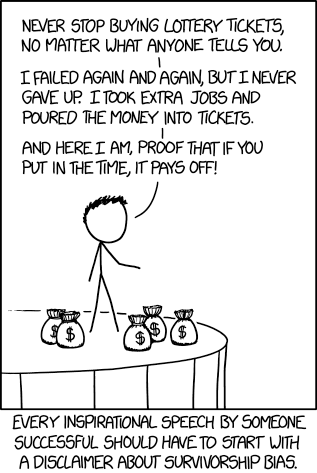
Source: XKCD (https://xkcd.com/1827/)
This is disturbingly relevant to those considering medicine, or those already in it. There are countless stories from people who have "made it", sharing their path to medicine and encouraging others to duplicate it. Some of these have merit. Many do not. The problem, as the XKCD comic notes, is the survivorship bias. There are many paths to and through medicine, but some are more risky than others. Those who achieve what could be considered to be a success naturally think they've got the inside track on how to become successful, because hey, it worked for them! I'm definitely guilty of this myself. Yet anecdotes are not data and what works for one person won't necessarily work for all people.
In medicine, the most common example of survivorship bias comes when considering attending medical school outside of Canada. It works for some people, people who are naturally pretty happy with the choice they made. Yet, we don't hear much from those who did not find success at a foreign medical school, who are understandably fairly shy about talking about their failures.
There are countless other situations where this holds true, however. There are many Canadian medical students who took some non-traditional paths to medicine. I did a second degree, for example. Others took comparatively difficult undergrads, such as engineering or art. Yet, while these paths work for some, I wouldn't call them reliable or optimal pathways to medicine.
I'd put CaRMS matching for Canadian medical students into this category as well. Successful candidates share their approach to matching to competitive programs, while those who didn't match, or matched low on their list generally don't share their often-very-similar stories.
The problem is that anecdotal data is often all students have to guide them. There isn't great data out there to say how to get into medical, how to land a good residency spot, or on the outcomes of studying medicine abroad. This is just my small reminder to treat every success story with a grain of salt, and to always, always, always have a reasonably reliable back-up plan in mind. Risk-taking is part of having a good career, as the only paths in life that come with guarantees are ones of mediocrity, yet gambling the future away in hopes of a payoff is never a recommended approach. Take the risks that still leave you standing if they don't work out - so that you can take the next chance that comes your way after that.
Saturday, 29 April 2017
Finances in Medicine - Big Life Expenses
As I move from student life to resident life, non-career life goals start to loom a little bit larger. At my age, many of my friends and colleagues are looking towards a few big expenses - getting a car, getting married, having kids, buying a house. None of these come cheap.
Car
This one's simple - most residencies require access to a vehicle, and in most cases, it's going to have to be your own vehicle. Buy something that fits your needs through residency that's reasonably low-maintenance (there's no time to be babying a fixer-upper). It shouldn't be a luxury vehicle. It'll likely be paid for through debt entirely and that's alright. It's a necessary business expense.
House
Ahh, the eternal debate - buy a house in residency or rent a place. In all honesty, there's no simple answer here, it'll depend on numerous factors. To the extent that there is any general advice, it's that the standard for Family Medicine residents is to rent, while the standard for those in 5-year specialties is to buy, but there are many exceptions to those guidelines.
The main reason to buy a house is to build equity with the money you're putting towards your living costs, thereby recouping some of that money rather than losing it as an expense outright. Buying a house becomes a forced investment - and a fairly good one at that - as the money paid towards a mortgage partially goes towards the house that you own, a house which is worth a lot of money and which will generally increase in price over time.
The main reason to rent is to avoid the costs and risks of homeownership. Spending money on rent is money that you'll never get back, but buying a house comes with its own expenses that will not be recouped. Maintenance, repairs, property taxes, interest (on the mortgage and, for residents, often on the down payment as well), closing costs, condo fees (if applicable) - all this adds up and is something renters don't need to deal with. Time is also a factor, as renting means that any housing issues that come up are the landlord's responsibility to deal with. Renting is also less risky, as houses can decline in value (but usually don't), and is more flexible if a move becomes necessary, as it often is for graduating residents.
All things considered, buying a house is usually a better financial decision in the long run. However, in the short-to-medium term, it comes with some distinct disadvantages. For those who have a little bit more medium term stability and a tolerance for some financial risk, it can be worthwhile. For those who face a bit more volatility in their upcoming housing needs or who are risk-averse, renting might be the better option and likely a bit cheaper in the short term. Regardless of the path chosen, all physicians will be able to afford a very nice property, likely a "forever home", only a few years after finishing residency - if not sooner.
Wedding
While everyone in residency needs transportation and housing, not everyone needs or wants to get married. Many do though, and the end of medical school is a prime time for it to happen. A good portion of my classmates just got married or have their wedding planned in the near future. Weddings, however, are expensive. Really expensive. Anything with a reception is likely to run at least $15k. More typical weddings are more in the $20-30k range. It's not hard to go above that upper end figure either. Oftentimes, these costs get offset by gifts from guests, either directly through money or through other gifts. Depending on the culture and attitudes of the guests, the entire cost of the wedding might be covered, but it's not something to count on either. For those uninterested in the traditional reception, a ceremony-only event is an option - whether it's the basic City Hall ceremony or a ceremony with more bells and whistles. The main cost of a wedding is the reception, and a very elegant ceremony can be funded for a fraction of the price of that reception.
Weddings are often financed by a combination of gifts, parental support, and debt. Fortunately, as a one-off event, most graduating medical students can afford that bit of extra debt without much difficulty. Still, when budgeting for the future, the expense of getting married should be in those calculations, because it is not a small one.
Children
Car
This one's simple - most residencies require access to a vehicle, and in most cases, it's going to have to be your own vehicle. Buy something that fits your needs through residency that's reasonably low-maintenance (there's no time to be babying a fixer-upper). It shouldn't be a luxury vehicle. It'll likely be paid for through debt entirely and that's alright. It's a necessary business expense.
House
Ahh, the eternal debate - buy a house in residency or rent a place. In all honesty, there's no simple answer here, it'll depend on numerous factors. To the extent that there is any general advice, it's that the standard for Family Medicine residents is to rent, while the standard for those in 5-year specialties is to buy, but there are many exceptions to those guidelines.
The main reason to buy a house is to build equity with the money you're putting towards your living costs, thereby recouping some of that money rather than losing it as an expense outright. Buying a house becomes a forced investment - and a fairly good one at that - as the money paid towards a mortgage partially goes towards the house that you own, a house which is worth a lot of money and which will generally increase in price over time.
The main reason to rent is to avoid the costs and risks of homeownership. Spending money on rent is money that you'll never get back, but buying a house comes with its own expenses that will not be recouped. Maintenance, repairs, property taxes, interest (on the mortgage and, for residents, often on the down payment as well), closing costs, condo fees (if applicable) - all this adds up and is something renters don't need to deal with. Time is also a factor, as renting means that any housing issues that come up are the landlord's responsibility to deal with. Renting is also less risky, as houses can decline in value (but usually don't), and is more flexible if a move becomes necessary, as it often is for graduating residents.
All things considered, buying a house is usually a better financial decision in the long run. However, in the short-to-medium term, it comes with some distinct disadvantages. For those who have a little bit more medium term stability and a tolerance for some financial risk, it can be worthwhile. For those who face a bit more volatility in their upcoming housing needs or who are risk-averse, renting might be the better option and likely a bit cheaper in the short term. Regardless of the path chosen, all physicians will be able to afford a very nice property, likely a "forever home", only a few years after finishing residency - if not sooner.
Wedding
While everyone in residency needs transportation and housing, not everyone needs or wants to get married. Many do though, and the end of medical school is a prime time for it to happen. A good portion of my classmates just got married or have their wedding planned in the near future. Weddings, however, are expensive. Really expensive. Anything with a reception is likely to run at least $15k. More typical weddings are more in the $20-30k range. It's not hard to go above that upper end figure either. Oftentimes, these costs get offset by gifts from guests, either directly through money or through other gifts. Depending on the culture and attitudes of the guests, the entire cost of the wedding might be covered, but it's not something to count on either. For those uninterested in the traditional reception, a ceremony-only event is an option - whether it's the basic City Hall ceremony or a ceremony with more bells and whistles. The main cost of a wedding is the reception, and a very elegant ceremony can be funded for a fraction of the price of that reception.
Weddings are often financed by a combination of gifts, parental support, and debt. Fortunately, as a one-off event, most graduating medical students can afford that bit of extra debt without much difficulty. Still, when budgeting for the future, the expense of getting married should be in those calculations, because it is not a small one.
Children
As with weddings, many people are opting not to have children, so this may be a non-issue for a growing number of physicians. For those that want kids, children require some serious financial planning. The cost of raising a child to adulthood averages over $250k in Canada, with expenses being higher in the early years. For physicians with generally high standards of living and above-average expectations for their children's care, that figure is likely an underestimate. That's a significant and continuous cost to bear.
Perhaps most challenging for those in medicine, children can't always be put off until later, while houses and weddings can be delayed indefinitely. The biological clock is an unavoidable fact of life for a career path that requires training into many physicians' early 30's or beyond. Women in medicine unquestionably bear the brunt of this reality more so than men, though men are not exempt from timelines either when it comes to having children. Timing therefore becomes a rather important decision. The longer physicians wait to have children, the more financially secure they'll be, but the older they'll be before trying to conceive or adopt.
A small number choose to have children in medical school. Time-wise, this can be a good option. Outside of clerkship, schedules are much lighter and more flexible than they are in residency. Medical schools often do allow time off for children, though this typical means being kept back a year and may mean an extra year of tuition payments. Medical students are, naturally, quite young as well. Money is an issue though, as medical students are piling on debt, not bringing in an income. Within reason, debt-financing child expenses can be done. However, other expenses will have to be kept under tight control unless a high-earning partner is in the picture, and careful financial management is a must.
Waiting until becoming an attending physician is a more common time frame to start having children. By this point demands on physician time have (usually) settled down and are much more flexible. There should be plenty of financial resources available by this point as well. The downsides are age and the hassle of practice management. Age is fairly self-explanatory when it comes to waiting until after residency, but practice management is an often-neglected factor. Unlike in medical school and residency, attending physicians are now fully responsible for their own careers. Taking time off to have a child means, in many cases, having to find someone to cover your practice. This can be particularly worrisome immediately post-residency, when a physician is still working to establish themselves and may not be able to easily take time off just yet. These immediate post-residency career demands can push the timeline to have children back even further than intended. Still, for those who are on the younger side, in shorter residency programs, or happy with being on the older side to start trying, waiting until after residency can be a rather sensible choice.
At the end of the day, residency remains a very popular time to start having children. Time is in exceedingly short supply, but taking maternity or paternity leave is relatively straight-forward. Residents aren't exactly overflowing with money, but they've got enough coming in to support a household. They're older than medical students, but younger than attendings, most being in their late-20's or early-30's, which is a fairly favourable time to start having kids. Residency remains the standard "recommended" time to have children for these reasons.
Nevertheless, circumstances will be different for every individual physician, and there are certainly merits to starting to have children either before or after residency. The timing of having children is a balancing act of competing priorities, and any decision will involve some trade-offs. Proper financial planning and lifestyle management remain the greatest assets when considering children.
Perhaps most challenging for those in medicine, children can't always be put off until later, while houses and weddings can be delayed indefinitely. The biological clock is an unavoidable fact of life for a career path that requires training into many physicians' early 30's or beyond. Women in medicine unquestionably bear the brunt of this reality more so than men, though men are not exempt from timelines either when it comes to having children. Timing therefore becomes a rather important decision. The longer physicians wait to have children, the more financially secure they'll be, but the older they'll be before trying to conceive or adopt.
A small number choose to have children in medical school. Time-wise, this can be a good option. Outside of clerkship, schedules are much lighter and more flexible than they are in residency. Medical schools often do allow time off for children, though this typical means being kept back a year and may mean an extra year of tuition payments. Medical students are, naturally, quite young as well. Money is an issue though, as medical students are piling on debt, not bringing in an income. Within reason, debt-financing child expenses can be done. However, other expenses will have to be kept under tight control unless a high-earning partner is in the picture, and careful financial management is a must.
Waiting until becoming an attending physician is a more common time frame to start having children. By this point demands on physician time have (usually) settled down and are much more flexible. There should be plenty of financial resources available by this point as well. The downsides are age and the hassle of practice management. Age is fairly self-explanatory when it comes to waiting until after residency, but practice management is an often-neglected factor. Unlike in medical school and residency, attending physicians are now fully responsible for their own careers. Taking time off to have a child means, in many cases, having to find someone to cover your practice. This can be particularly worrisome immediately post-residency, when a physician is still working to establish themselves and may not be able to easily take time off just yet. These immediate post-residency career demands can push the timeline to have children back even further than intended. Still, for those who are on the younger side, in shorter residency programs, or happy with being on the older side to start trying, waiting until after residency can be a rather sensible choice.
At the end of the day, residency remains a very popular time to start having children. Time is in exceedingly short supply, but taking maternity or paternity leave is relatively straight-forward. Residents aren't exactly overflowing with money, but they've got enough coming in to support a household. They're older than medical students, but younger than attendings, most being in their late-20's or early-30's, which is a fairly favourable time to start having kids. Residency remains the standard "recommended" time to have children for these reasons.
Nevertheless, circumstances will be different for every individual physician, and there are certainly merits to starting to have children either before or after residency. The timing of having children is a balancing act of competing priorities, and any decision will involve some trade-offs. Proper financial planning and lifestyle management remain the greatest assets when considering children.
Thursday, 7 January 2016
Family Medicine
Clerkship is when most people pin down their specialty choice, and that looks to be the case for me as well. It's only 4 months into clerkship and my preferences have definitely changed. Moreover, I'm a lot more certain in my selection. There's still room for change, but I've pretty well stratified the specialties on my short list, and I've only got one major rotation that could change things, so I think I'm set.
Without much fanfare, my current plan is to aim for Family Medicine.
Ironically, the rotation I haven't done yet that might change my mind is Family Medicine. If I have a truly awful experience there it'd certainly alter my approach, but at this point I've had quite a bit of direct FM exposure and generally enjoyed it, so I don't see that happening. Even if I don't find my FM rotation as exhilarating as some other rotations, that probably won't change my plans, the rotation just has to be sufficiently pleasant.
My thought process here isn't all that unique, and I've been a bit hesitant to make this post at all, but I figure it's worth spelling out.
1) I like outpatient medicine
Through my rotations thus far, there's been a bit of a recurring theme: I love my time in outpatient clinics (I'll throw ER in there as well), but get completely worn out by inpatient services. Basically if I can see a patient for a short period of time and send them on their way, I'm pretty happy. These services tend to have a bit more face-to-face time with patients, which is a big plus for me.
Inpatient medicine I find tends to get bogged down in bureaucracy and problematic miscommunications are routine. Too many providers with too little coordination between them. There's a reason being in hospital is a major risk factor for death and while it's a problem I would love to tackle at some point in my career, it's not an environment I particularly want to practice in for an extending period of time. Maybe community hospitals, with fewer services to manage, do a better job of this, but that brings me to my next point...
2) I want a residency that reflects my outpatient preference
There are a number of specialties that allow for a primarily-outpatient practice, not just family medicine. The problem is that most of them require a rather inpatient-heavy residency, especially in the first few years. I don't think I would enjoy years of an inpatient-dominated residency. Residency may be a short time compared to a whole career, but 5 years isn't exactly nothing. I'm coming up on my 5 year anniversary with my SO and it feels like a lifetime - a very happy one - since I met them. Add on the inevitable fellowship(s) required in many fields and the time difference between FM and Royal College specialties becomes pretty substantial. I don't want to spend that amount of time being miserable. FM doesn't avoid all inpatient work, but it does limit it to about 9 months or so maximum, mostly in the first year.
3) I'm eager to practice
To put things bluntly, a short residency is very attractive. I've mentioned before that I have some life goals to accomplish over the next 10 years or so, the biggest and most time-sensitive one being kids. A shorter residency means maybe having them after residency or at least getting to a point of professional and financial independence early in their lives.
I'm also getting a little tired of being a learner. Not tired of learning, of course, just tired of having that learning be subject to a bunch of extra requirements that come with being a learner - directed (rather than independent) learning goals, the endless evaluations, rapidly shifting from topic to topic... I'd like to be more able to tailor my education to my needs, rather than what others have determined I need to study. That won't likely happen until I'm out in practice.
4) I want a job
Few specialties have great job prospects and none are as flexible as Family Medicine. It's one thing to put in extra time to be a specialist, it's another matter entirely to do so without a desirable job at the end of it. There are one or two specialties that might be worth the extra training time, but not if I can't get a job I'm happy with at the end. FM pretty much comes with a guarantee of reasonable employment and for the foreseeable future, also a guarantee of location preference.
5) Trading ambition for stress reduction
The main thrust of my thought process leading to Family Medicine is stress reduction. Outpatient medicine is less stressful to me, for a variety of reasons. A residency that's shorter and outpatient-focused is similarly less stressful. Knowing I'd have a job at the end is a huge stress reducer.
In many ways, simply making the choice to pursue FM has been in keeping with the goal of stress reduction. FM doesn't require amazing LORs, heavy research experience, or specific electives to have a successful match. I've been able to focus on clerkship rotations more than filling out my CV, my elective choices have reflected my preferences rather than those of program directors, and I'll have many more options for where to do my residency. I wanted to take back some control over my education and my life - simply making the choice to pursue Family not only helps that goal in the future, it had an impact right now. I really can't express how much a difference that sense of control has made to my own well-being.
Sunday, 2 August 2015
The Value of Research (or lack thereof)
Okay, misleading title, of course research is important! It's how we figure out what things are true and what things aren't!
Yet for people on the spectrum of training to become a physician, the value of participating in research in terms of the potential benefit to their careers is real and, at times, troubling issue.
Medicine is undeniably linked with research. It is a rapidly evolving discipline, which draws on knowledge from virtually every field of research to develop, design, discover, and test new, presumably better ways of keeping people healthy. Understanding research is essential to the good practice of medicine and medicine doesn't improve without good-quality research. Physicians in particular have a large role in this - physicians often conduct their own research or enable research activities as part of a larger group. They can also stifle research performed by others. In clinical research, the most valuable resource is access to patients and their medical information. Obtaining access to these patients often goes through physicians, or at least involves their consent and cooperation. Without an interest in or support of research, physicians can deny or significantly hamper clinical research initiatives.
As a result, research is often considered valuable in terms of improving a person's CV at virtually every stage of training. Research helps undergrads become medical students (though not at all schools and probably not as much as some pre-meds think). Research helps medical students obtain their desired residency positions. Research helps residents get their desired fellowships and/or their desired employment. Even after employment, research productivity can enhance their career prospects.
Yet being a good physician doesn't necessarily require being a good researcher, or even a mediocre one. It is entirely possible to be able to understand emerging research without producing your own. Furthermore, while physicians resistant to research can hamper its progress, physicians do not need to lead or even be active participants in the research process to be supportive of research involving the patients they see.
And to be clear, some physicians and physicians-to-be hate conducting research. However, because it is so highly valued at each stage in the process of becoming a physician, including working in medicine, many people feel compelled to engage in the research process even if they would generally prefer not to. It's a hoop they have to jump through, nothing more.
So, should physician careers hinge as much as they do on research output? Should research output matter at all? Are we creating a perverse incentive scheme by placing a value on research throughout the career checkpoints of medicine?
There are certainly people at all stages of training and practice who would argue we shouldn't put any emphasis on research productivity in medicine, or at least clearly separate research achievements from progress in clinical ability. There are others who argue that physician disinterest or inability in a research sense is holding back the progress of medicine, to the detriment of the patients these physicians treat.
For my part, I engage in quite a bit of research and will likely continue to do so for most of my career. But I do this because I enjoy participating in research! I learn a lot from my time doing research and I'm willing to go to some extremes to be a more active researcher. I had my last set of pre-clerkship exams a few months ago, with four exams in five days - Monday, Tuesday, Thursday, and Friday. On the Wednesday of that week I presented some of my research at an international conference. Spent hundreds of dollars in conference fees (it was a week-long conference), 8 hours in a car, and lost the one day I had to relax/study during my exam week for 15 stress-inducing minutes on a stage in front of people much smarter than I am. Totally worth it. It'll look good on my CV, don't get me wrong (competition for an oral presentation is fairly high at this conference, I'm told), but I could have had a colleague do the presentation and it still would have looked good on my CV. I just really enjoyed the experience, even though it was not my first (nor, I hope my last) time presenting my research in such a manner.
So I'm torn on this issue. I've seen first hand the value of research, both to society at large and to the competencies of individual physicians-to-be. I've also seen how hard it can be for intelligent, interested, and even experienced researchers to be productive in their field without physician support. However, I've also seen first hand how the insistence on research can frustrate and depress physicians or physicians-in-training who would rather focus on doing the best they can for the patients in front of them, which is, ultimately, their primary duty. I don't have a good answer of how to reconcile these observations.
Any thoughts from the audience?
Subscribe to:
Posts (Atom)