The tragic story of Dr Robert Chu is making the rounds on social media after a profile in the Toronto Star and an accompanying piece about the troublesome nature of the CaRMS match that did not provide him a residency position despite two application cycles. His is a horrific end that highlights the high-stress, low-support nature of medicine in general, but particularly for those who hit speed bumps on their path to becoming a physician.
Many words have been written or spoken about how to remedy situations like this and prevent outcomes like Dr Chu's. These are important topics to discuss which for far too long have been left unaddressed in actions if not in words. I wish these conversations were happening independent of this story, however, as there is so much unknown about Dr Chu's situation that it prevents his particular circumstances from being meaningfully addressed and throws his death into the middle of a discussion that is much, much bigger than his individual story, significant as it is.
There are numerous responses being discussed, but I wanted to focus on one of them. Namely, that having an MD, even without any residency training, should permit someone to work in healthcare in some capacity. Indeed, an MD is rather unique among degrees in that, on its own, means very little. Even in fields where additional training is often necessary, the introductory degree still holds value and can be used to pursue various career paths. The MD is, in effect, a useless degree.
This idea has been circulating among American physicians for some time, even if it hasn't gained much traction in Canada, in no small part due to the increasing presence of Physician Assistants (PAs) and Nurse Practitioners (NPs) in the US. Particularly when it comes to PAs, American physicians see people who have spent less time training than a freshly-graduated MD who cannot work independently, but are able to essentially practice medicine under a qualified physician. This begs the question as to why MDs who were unable to match couldn't do the same. It may not even be overly difficult to set up such a system, as PAs don't have much legal authority themselves, but work under the framework of delegation legislated for physicians. The legal and regulatory framework is largely in place already to allow supervised MD practice without residency, under the direction of a fully-trained physician.
Yet, as things currently stand, I would not being in favour of letting MDs practice in a manner similar to PAs. While MD training is longer, and thus both deeper and broader than that for PAs, it's not particularly functional. MDs are trained more to know rather than to do. PAs are trained to work as they were intended as soon as they graduate. A fresh PA is essentially an extra arm to a physician, allowing them to do more using their already-established knowledge. A fresh MD is more like an extra brain, which isn't particularly helpful to a fully-trained physician who already has that knowledge in spades.
Updating training within MD programs to emphasize practical skills above knowledge could solve this problem and set physicians up to have some sort of back-up option if they fail to land a residency. I'd far prefer a set-up like this with continual supervised practice as opposed to something like the old rotating internship leading to the ability to work as a GP after only a year of post-graduate training. This would require a fairly massive shift in medical education from the current approach, all at a time when getting even small adjustments is an uphill battle. Still, I believe that making medical student education more practical and focused on what we do rather than what we know is worthwhile on its own merits, independent of its implications for the job market.
So, it's an option I think should be considered in these sorts of discussions. It's not the simplest solution (that would be simply making moves to improve the student-to-residency spot ratio) and it's not without its flaws. However, I think it could fit into a broader approach to improving medical education that moves the profession forward.
Tuesday, 27 June 2017

Tuesday, 13 June 2017
Ontario Binding Arbitration Framework
The OMA and the Ontario Government, against all odds, have come to an agreement. A preliminary one. On how to approach a real agreement. This isn't a physician services agreement, which is what would be needed to provide for a real update of physician funding schemes, but it's a start. Effectively, this sets the stage for negotiations and provides a framework to come to an agreement through a binding arbitration system.
In rejecting the previous tentative physician services agreement, I had two main concerns. First, that the presence of a defined, limited physician services budget with clawbacks on physicians as a whole put too much responsibility on individuals physicians for results beyond their power to affect. Worse, it set up an economic situation that would further encourage physicians to bill and practice in ways that advantaged them at the expense of patients, taxpayers, and their own colleagues. Second, it did not provide any protections for physicians against decision-making of the Ontario government, which is vitally important as physicians have minimal protections from current labour laws and no practical ability to strike in the event of a protracted labour dispute.
This agreement, the Binding Arbitration Framework, effectively has the Ontario government yielding the second point entirely. If this framework is agreed to, we have binding arbitration now and, by the looks of it, moving forward to future negotiations. It appears to be a reasonable solid arrangement, without much in the way of loopholes. The worst criticism I've read is that the government maintains policy-making rights, including which services should be funded which... of course they do. I doubt we could remove that in an agreement regardless of how it was written, thanks to the current Canadian constitution and the Canada Health Act. This was always going to be a loophole, but it'd be extremely inconvenient - politically and legally - for the government to take advantage of this under the proposed framework.
More interestingly, the framework touches on the first point of concern I had as well. It doesn't remove a set physician services budget, which I still find worrisome, but neuters its effectiveness considerably. First, it makes the budget subject to binding arbitration. Second, it explicitly dictates factors that an arbiter should consider, most importantly demographic changes. It does include consideration for the economic situation in Ontario, which is troublesome from an administration that has used any hint of economic weakness to justify public service cuts, but could end up being beneficial as well, as economic strength should work in our favour. Third, and most importantly, breaches in the cap on the physician services budget do not automatically result in punitive action against physicians. Rather, breaches will be subject to arbitration, where it can be determined to what extent, if any, physicians are responsible. Additionally, any punitive actions are subject to negotiation and arbitration, meaning more targeted cuts are possible, in contrast to the current approach of across-the-board cuts. I'd rather see the physician services budget cap removed entirely, but this is a reasonably well-tailored way to maintain its existence while blunting the more objectionable aspects to such a cap.
Some other objections to this agreement have been raised, however. First is that it generally precludes negotiation on the unilateral changes enacted since 2014. Yet, I haven't seen any indication this would be on the table - even the most favourable labour decisions wouldn't include significant back-payments and the OMA has little bargaining power for this time (due in no small part to its own actions). There's what's ideal and there's what's realistic; getting any meaningful compensation for the last 3 years during (failed) negotiations seems like a pipe dream more than anything. Second, the agreement limits ability to engage in strikes or job actions that directly affect patient care... which we couldn't (and shouldn't) do anyway. Job actions that negatively affect patient care in a meaningful way, including strikes, contravene recommended ethical guidelines, including those listed by the CPSO, our regulatory body. Furthermore, physician strikes don't work. The history of them in Canada is full of physicians losing badly. While recognizing a significant desire among Ontario physicians to engage in job actions, if this agreement prevents that, it'll only be saving us from ourselves.
I think I've painted a fairly clear picture of where I stand on this framework. It's not perfect, far from it. Yet, it gives Ontario physicians clear, long-term wins that looked unlikely even a few months ago. The compromises for those wins, while not insignificant, are tolerable. Critically, these benefits come before money is even on the table - I honestly figured that to gain some of these concessions moving forward, physicians would have to endure more financial pain in the short-term. To have them arranged in advance of the negotiations for the current physician services agreement would be a welcome surprise. I rejected the previous tPSA, loudly and proudly. I just voted in favour of this framework.
In rejecting the previous tentative physician services agreement, I had two main concerns. First, that the presence of a defined, limited physician services budget with clawbacks on physicians as a whole put too much responsibility on individuals physicians for results beyond their power to affect. Worse, it set up an economic situation that would further encourage physicians to bill and practice in ways that advantaged them at the expense of patients, taxpayers, and their own colleagues. Second, it did not provide any protections for physicians against decision-making of the Ontario government, which is vitally important as physicians have minimal protections from current labour laws and no practical ability to strike in the event of a protracted labour dispute.
This agreement, the Binding Arbitration Framework, effectively has the Ontario government yielding the second point entirely. If this framework is agreed to, we have binding arbitration now and, by the looks of it, moving forward to future negotiations. It appears to be a reasonable solid arrangement, without much in the way of loopholes. The worst criticism I've read is that the government maintains policy-making rights, including which services should be funded which... of course they do. I doubt we could remove that in an agreement regardless of how it was written, thanks to the current Canadian constitution and the Canada Health Act. This was always going to be a loophole, but it'd be extremely inconvenient - politically and legally - for the government to take advantage of this under the proposed framework.
More interestingly, the framework touches on the first point of concern I had as well. It doesn't remove a set physician services budget, which I still find worrisome, but neuters its effectiveness considerably. First, it makes the budget subject to binding arbitration. Second, it explicitly dictates factors that an arbiter should consider, most importantly demographic changes. It does include consideration for the economic situation in Ontario, which is troublesome from an administration that has used any hint of economic weakness to justify public service cuts, but could end up being beneficial as well, as economic strength should work in our favour. Third, and most importantly, breaches in the cap on the physician services budget do not automatically result in punitive action against physicians. Rather, breaches will be subject to arbitration, where it can be determined to what extent, if any, physicians are responsible. Additionally, any punitive actions are subject to negotiation and arbitration, meaning more targeted cuts are possible, in contrast to the current approach of across-the-board cuts. I'd rather see the physician services budget cap removed entirely, but this is a reasonably well-tailored way to maintain its existence while blunting the more objectionable aspects to such a cap.
Some other objections to this agreement have been raised, however. First is that it generally precludes negotiation on the unilateral changes enacted since 2014. Yet, I haven't seen any indication this would be on the table - even the most favourable labour decisions wouldn't include significant back-payments and the OMA has little bargaining power for this time (due in no small part to its own actions). There's what's ideal and there's what's realistic; getting any meaningful compensation for the last 3 years during (failed) negotiations seems like a pipe dream more than anything. Second, the agreement limits ability to engage in strikes or job actions that directly affect patient care... which we couldn't (and shouldn't) do anyway. Job actions that negatively affect patient care in a meaningful way, including strikes, contravene recommended ethical guidelines, including those listed by the CPSO, our regulatory body. Furthermore, physician strikes don't work. The history of them in Canada is full of physicians losing badly. While recognizing a significant desire among Ontario physicians to engage in job actions, if this agreement prevents that, it'll only be saving us from ourselves.
I think I've painted a fairly clear picture of where I stand on this framework. It's not perfect, far from it. Yet, it gives Ontario physicians clear, long-term wins that looked unlikely even a few months ago. The compromises for those wins, while not insignificant, are tolerable. Critically, these benefits come before money is even on the table - I honestly figured that to gain some of these concessions moving forward, physicians would have to endure more financial pain in the short-term. To have them arranged in advance of the negotiations for the current physician services agreement would be a welcome surprise. I rejected the previous tPSA, loudly and proudly. I just voted in favour of this framework.
Saturday, 3 June 2017
The Worst Part of Medical Training
While working on another post, I found the following paragraphs saved as a draft post. I'm not sure if I'm the author of these words and suspect that I'm not, yet can't find who wrote them originally. I have a feeling this was a forum post that ended up getting deleted, that I copied because I felt the words were worth saving.
I present them here as I found them in my draft folder - if the original author comes across this and wants them removed, I will happily do so. However, I think these paragraphs provide an important context to medical training which should be shared.
I present them here as I found them in my draft folder - if the original author comes across this and wants them removed, I will happily do so. However, I think these paragraphs provide an important context to medical training which should be shared.
"I have to highlight this for those considering or early in their medical training, because it's a part of medical training no one appreciates until they're in it.
As a trainee, there will be times where a patient's treatment is below what you consider acceptable. The worst is when there's a preceptor acting completely inappropriately. All you can do is sit back and watch the carnage unfold. If you're lucky, you'll be able to debrief the patient and provide some more appropriate guidance, as well as a bit of simple human empathy.
More often you're simply a cog in a system failing patients that, because you're new to that system, you don't understand and are ill-equipped to navigate. You act the way you think you're supposed to act, even the way others expect you to act, and it causes harm to patients in one way or another. Everyone goes along like it's normal or, worse, thanks you for your part in it. Yet, you have to continue with your role as that cog, because as a trainee, you have no alternative short of quitting. As you gain experience, becoming more knowledgeable about medicine as well as the healthcare system you're now a part of, you start to see opportunities to work around the system to avoid causing harm, to lessen it, or at least to warn patients of what's coming so they aren't blindsided.
This is the worst part of medical training - not the long hours, not the pressure to perform, not the vast amount of knowledge you need to acquire, not even the (fortunately uncommon in my experience) instances where you're personally treated poorly by preceptors - but the time where you're made to be complicit in bad care or outright mistreatment of patients. You don't have the power to change it, and so ultimately you aren't responsible for it, but it sure doesn't feel like it at the time."
I am now about a month away from starting my residency. This is definitely the part of my medical education thus far that I hated the most. It's the part of my upcoming residency I most fear. This is the dark side of medicine, the part that doesn't just challenge your ability, but compels you towards the corruption of your own ideals - ideals which the profession purports to share and uphold, yet frequently betrays.
Saturday, 27 May 2017
Working Hard and Being Successful
I've been reading about and discussing socioeconomic barriers to success lately, particularly as it relates to medicine. I also had an opportunity to be a very small part of an outreach program aimed at increasing interest in medicine in youth from disadvantaged backgrounds. One aspect to socioeconomic disadvantage I've found myself increasingly reflecting on is how multifaceted and variable this disadvantage can be. Thinking back, I've found most conversations on socioeconomic disadvantage tend to treat it as more uniform or monolithic than it is, and I've fallen into that trap of thinking too often as well. Perhaps others have come to this realization and I'm just behind in the thought-process, but I'd like to take a post to spell things out a little bit for my own sake.
To be perhaps a bit over-simplistic, I see a few distinct ways in which low socioeconomic status can manifest itself into real barriers to achievement. First is a simple lack of resources, which tends to be the focus of many interventions to assist those from lower socioeconomic backgrounds. It's undoubtedly a major problem - if some people can pay for things that others can't, and those things either directly or indirectly lead to personal achievement, then wealthier individuals will naturally benefit over their less-wealthy counterparts. In medicine these lead to some obvious and not-so-obvious barriers. To get into medicine, a student needs to pay for their undergraduate education, the MCAT, application fees, travel to interviews, and interview attire. These are not small expenses, especially when added together. However, that's just the bare minimum. Things money can buy that aren't necessary, but very helpful for getting into medical school include taking extra courses or second degrees (or even doing medical school outside of Canada), taking various prep courses or receiving extra tutoring, spending more time on unpaid extra-curriculars, or even paying for certain extra-curriculars.
Yet these examples hit only the "economic" portion of socioeconomic status. To get into medical school, there is also a significant social component that I don't believe gets recognized as often as it perhaps should. One is the development of baseline skills that many people take for granted. To use an extreme example, if a person was never taught how to read, they won't get into medical school, no matter how intelligent, responsible, and personable they might be. They can, of course, learn how to read and then start to move towards medicine, but it's a difficult skill to learn in adulthood and fundamental to all the steps that come after it. It's also a skill that typically requires significant support from others. We're lucky that in Canada most people get that support as children, but there are other skills which are not provided as reliably by our primary or secondary education system. One that springs to mind is professional communication skills, which are sorely lacking in formal education. The ability to write a concise, polite, effective e-mail has enormous benefits in securing various opportunities on a path to medicine, yet this may not be a skill some individuals even see from their elders or peers if they grow up in a setting without business people or other professionals in their lives. It's a skill that can be developed, but this takes time, support, and a certain degree of trial-and-error that more initiated individuals will not have to go through.
Likewise, access to opportunities is far from equitable across individuals of different social status. One example that comes to mind is students who happen to have physicians as parents. These parents hear about or inquire about opportunities with their colleagues and provide a point of introduction for their children. These students must still show they are worthy of those opportunities and perform well once they secure them to advance further, but that first step is often a critical one. More importantly, opportunities create a snowball effect, where prior experience justifies acceptance to future opportunities, up to and including medical school. That is, individuals with higher social status and more connections can turn into seemingly more capable applicants - and may actually be more capable applicants - due to these connections, completely unrelated to ability or effort.
I'd like to emphasize that higher socioeconomic status does not remove the need for hard work or eliminate the role of a certain degree of natural ability in the process. Medicine, like many fields, is full of well-off individuals, but these people have nevertheless put in significant effort to get to where they are. However, what my recent experiences have reminded me of is that while hard work is necessary for success, it is not sufficient on its own, hence the title of this piece. Without trying to set up too much of a strawman, I think some well-off individuals give too much credit to their own hard work in achieving success, because they started to see success when they started putting in the effort. Yet these individuals started seeing success after they started to work harder towards success because everything else was already set up for them. I've met plenty of people who haven't had the same experience, where hard work perhaps improved their situations, but that improvement was limited due to factors beyond their control.
Bringing this back to the original point about the multifaceted nature of socioeconomic disadvantage for a minute, I now worry more that many interventions to improve such disadvantage are perhaps too simplistic to be effective. We can throw money at a problem but it can end up being a waste if the more social aspects to disadvantage are left unaddressed. On the flip side, we could try to improve these social elements, yet see minimal results if resources are still lacking. However, on a more positive note, this also means that there are many different ways we can make marginal improvements in peoples' lives. If we don't have money to help, we can volunteer time to teach new skills, or provide connections that might otherwise being lacking. If we're busy and running off our feet, financial supports can nevertheless be valuable. When people move up the socioeconomic ladder, patchwork systems of support like this can be an important reason why, allowing them to fully utilize their own natural talents and work ethic.
From a personal perspective, as I move forward within my own career in medicine, I'm hoping there will be more opportunities to level the playing field a little bit - and I hope I'll have the good sense to recognize when those opportunities arise.
To be perhaps a bit over-simplistic, I see a few distinct ways in which low socioeconomic status can manifest itself into real barriers to achievement. First is a simple lack of resources, which tends to be the focus of many interventions to assist those from lower socioeconomic backgrounds. It's undoubtedly a major problem - if some people can pay for things that others can't, and those things either directly or indirectly lead to personal achievement, then wealthier individuals will naturally benefit over their less-wealthy counterparts. In medicine these lead to some obvious and not-so-obvious barriers. To get into medicine, a student needs to pay for their undergraduate education, the MCAT, application fees, travel to interviews, and interview attire. These are not small expenses, especially when added together. However, that's just the bare minimum. Things money can buy that aren't necessary, but very helpful for getting into medical school include taking extra courses or second degrees (or even doing medical school outside of Canada), taking various prep courses or receiving extra tutoring, spending more time on unpaid extra-curriculars, or even paying for certain extra-curriculars.
Yet these examples hit only the "economic" portion of socioeconomic status. To get into medical school, there is also a significant social component that I don't believe gets recognized as often as it perhaps should. One is the development of baseline skills that many people take for granted. To use an extreme example, if a person was never taught how to read, they won't get into medical school, no matter how intelligent, responsible, and personable they might be. They can, of course, learn how to read and then start to move towards medicine, but it's a difficult skill to learn in adulthood and fundamental to all the steps that come after it. It's also a skill that typically requires significant support from others. We're lucky that in Canada most people get that support as children, but there are other skills which are not provided as reliably by our primary or secondary education system. One that springs to mind is professional communication skills, which are sorely lacking in formal education. The ability to write a concise, polite, effective e-mail has enormous benefits in securing various opportunities on a path to medicine, yet this may not be a skill some individuals even see from their elders or peers if they grow up in a setting without business people or other professionals in their lives. It's a skill that can be developed, but this takes time, support, and a certain degree of trial-and-error that more initiated individuals will not have to go through.
Likewise, access to opportunities is far from equitable across individuals of different social status. One example that comes to mind is students who happen to have physicians as parents. These parents hear about or inquire about opportunities with their colleagues and provide a point of introduction for their children. These students must still show they are worthy of those opportunities and perform well once they secure them to advance further, but that first step is often a critical one. More importantly, opportunities create a snowball effect, where prior experience justifies acceptance to future opportunities, up to and including medical school. That is, individuals with higher social status and more connections can turn into seemingly more capable applicants - and may actually be more capable applicants - due to these connections, completely unrelated to ability or effort.
I'd like to emphasize that higher socioeconomic status does not remove the need for hard work or eliminate the role of a certain degree of natural ability in the process. Medicine, like many fields, is full of well-off individuals, but these people have nevertheless put in significant effort to get to where they are. However, what my recent experiences have reminded me of is that while hard work is necessary for success, it is not sufficient on its own, hence the title of this piece. Without trying to set up too much of a strawman, I think some well-off individuals give too much credit to their own hard work in achieving success, because they started to see success when they started putting in the effort. Yet these individuals started seeing success after they started to work harder towards success because everything else was already set up for them. I've met plenty of people who haven't had the same experience, where hard work perhaps improved their situations, but that improvement was limited due to factors beyond their control.
Bringing this back to the original point about the multifaceted nature of socioeconomic disadvantage for a minute, I now worry more that many interventions to improve such disadvantage are perhaps too simplistic to be effective. We can throw money at a problem but it can end up being a waste if the more social aspects to disadvantage are left unaddressed. On the flip side, we could try to improve these social elements, yet see minimal results if resources are still lacking. However, on a more positive note, this also means that there are many different ways we can make marginal improvements in peoples' lives. If we don't have money to help, we can volunteer time to teach new skills, or provide connections that might otherwise being lacking. If we're busy and running off our feet, financial supports can nevertheless be valuable. When people move up the socioeconomic ladder, patchwork systems of support like this can be an important reason why, allowing them to fully utilize their own natural talents and work ethic.
From a personal perspective, as I move forward within my own career in medicine, I'm hoping there will be more opportunities to level the playing field a little bit - and I hope I'll have the good sense to recognize when those opportunities arise.
Saturday, 20 May 2017
The Rise of Anti-Aging Technologies
Anti-aging technology is a relatively small, but rapidly-growing sector of research and development. Several research groups have been established, both in academia and in the corporate world. The corporate side is particularly interesting as venture capitalists are starting to throw money their way and even some big players, like Google, have directly entered the market. In Google's case, its start-up Calico, is clearly well-funded but shrouded in mystery, with little information provided publicly and seemingly few connections with academics or other companies working on anti-aging approaches.
It's an intriguing concept from a physician perspective, since our work is directly towards the extension and improvement of human lives, and age is a fairly significant non-modifiable risk factor in many, many diseases. Yet, it's hard to know what to make of these research efforts given the grandeur and complexity of the task, as well as the relative opaqueness of the field. So, I was glad to come across this interview with Aubrey de Grey, who rather passionately makes the case for continued anti-aging research, its plausibility, its potential, and then responds to societal critiques against the notion of anti-aging research entirely.
Dr de Grey's viewpoints provide an excellent window into the field of anti-aging research, but I admit to being a bit unconvinced on several of his points. First and foremost, on the technological side, there's promise, but in many cases, little more than that. One example Dr de Grey points to is the use of stem cells in degenerative diseases, like Parkinson's. While research on this issue is on-going and far from being exhausted, the promise of stem cell research has been touted for a few decades now without much success in reaching clinical treatments. I fully expect some breakthroughs in stem cell research, yet it's hard to have confidence that these will come soon, or that they will be as all-encompassing as has at times been promised. More likely, we'll see slow, incremental progress. Considering Dr de Grey's anti-aging framework requires such ambitious goals as effectively curing all major cancers - and I'd agree that's a necessity to substantially extend human life given that cancer incidence rises quickly with age - there's good reason to be skeptical that technologies are close to achieving his aims.
Regarding the societal critiques, namely inequality and overpopulation, I also feel the tone Dr de Grey sets is overly optimistic. For inequality, we already see fairly significant differences in access to healthcare based on cost. Any anti-aging costs stand to be rather expensive, if the level of investment in the potential anti-aging technologies is any indication. Even in a socialized healthcare system such as Canada's, this will be a concern. One example that springs to mind is the introduction of sofosbuvir (Sovaldi) for the treatment of Hepatitis C. It is a very expensive drug, but because it is so effective compared to previously-existing alternatives, it is actually a fairly cost-effective therapy by current metrics. Yet, provincial governments have been reluctant to fully-fund this drug due to its high cost. In Ontario, the sofosbuvir is only covered if a patient with Hepatitis C meets one of several requirements, even for those with provincially-funded drug plans, despite the indication for sofosbuvir being much more expansive than allowed for by these requirements. Even though sofosbuvir is effective and cost-effective, its upfront costs present a challenge for cash-strapped provinces. This is all for a drug that hits only a sliver of the population. Anti-aging drugs, which could in theory apply to everyone, will present much more a challenge, even if they work exactly as intended for a reasonable cost.
Overpopulation is, in my mind, a bit of a non-issue at this time since I'm skeptical anti-aging technologies will see widespread usage, but assuming they do, it becomes a serious concern. Dr de Grey notes that those who live longer can also contribute to society longer and thereby produce enough resources to justify their continued existence. This is absolutely true, but runs into problems when resources are constrained by more than manpower. Without starting down a whole different tangent, we are hitting the point where natural resources, which are independent of human work, are depleting far faster than they are being replaced. On top of this, we have a huge swath of humanity living on fewer resources than most of us would consider acceptable. While I believe this is a surmountable problem, it's not an easily-addressed one. Indeed, the world has been failing to adequately manage the shortcomings in our usage of natural resources relative to supply for decades at least, despite concerted efforts by many committed individuals, non-profits, and governments.
Lastly, an additional societal concern wasn't discussed in the article - the value of human turnover. That's a morbid thought, but our society relies on people moving onto new things, retiring from the workforce, or yes, even dying, in order to continue advancing forward. Older people carry with them older ideas and are more likely to have build up the power to implement them. Some of these are worth preserving. Others need to be let go. Longer life spans and longer careers means established ideas stay established longer, less pliable to the innovations of the young. Once again, this is a surmountable concern, and societies could adapt to a new normal of long-lived individuals, but I wouldn't be confident that this would be a seamless transition.
In short, I'm intrigued, but skeptical of this renewed anti-aging push. There are technical challenges that are far from simple to overcome. There are societal challenges that would have wide ranging impacts if not adequately addressed. Whether anti-aging efforts see success or failure, I'll be keeping my eye out for updates in this field.
It's an intriguing concept from a physician perspective, since our work is directly towards the extension and improvement of human lives, and age is a fairly significant non-modifiable risk factor in many, many diseases. Yet, it's hard to know what to make of these research efforts given the grandeur and complexity of the task, as well as the relative opaqueness of the field. So, I was glad to come across this interview with Aubrey de Grey, who rather passionately makes the case for continued anti-aging research, its plausibility, its potential, and then responds to societal critiques against the notion of anti-aging research entirely.
Dr de Grey's viewpoints provide an excellent window into the field of anti-aging research, but I admit to being a bit unconvinced on several of his points. First and foremost, on the technological side, there's promise, but in many cases, little more than that. One example Dr de Grey points to is the use of stem cells in degenerative diseases, like Parkinson's. While research on this issue is on-going and far from being exhausted, the promise of stem cell research has been touted for a few decades now without much success in reaching clinical treatments. I fully expect some breakthroughs in stem cell research, yet it's hard to have confidence that these will come soon, or that they will be as all-encompassing as has at times been promised. More likely, we'll see slow, incremental progress. Considering Dr de Grey's anti-aging framework requires such ambitious goals as effectively curing all major cancers - and I'd agree that's a necessity to substantially extend human life given that cancer incidence rises quickly with age - there's good reason to be skeptical that technologies are close to achieving his aims.
Regarding the societal critiques, namely inequality and overpopulation, I also feel the tone Dr de Grey sets is overly optimistic. For inequality, we already see fairly significant differences in access to healthcare based on cost. Any anti-aging costs stand to be rather expensive, if the level of investment in the potential anti-aging technologies is any indication. Even in a socialized healthcare system such as Canada's, this will be a concern. One example that springs to mind is the introduction of sofosbuvir (Sovaldi) for the treatment of Hepatitis C. It is a very expensive drug, but because it is so effective compared to previously-existing alternatives, it is actually a fairly cost-effective therapy by current metrics. Yet, provincial governments have been reluctant to fully-fund this drug due to its high cost. In Ontario, the sofosbuvir is only covered if a patient with Hepatitis C meets one of several requirements, even for those with provincially-funded drug plans, despite the indication for sofosbuvir being much more expansive than allowed for by these requirements. Even though sofosbuvir is effective and cost-effective, its upfront costs present a challenge for cash-strapped provinces. This is all for a drug that hits only a sliver of the population. Anti-aging drugs, which could in theory apply to everyone, will present much more a challenge, even if they work exactly as intended for a reasonable cost.
Overpopulation is, in my mind, a bit of a non-issue at this time since I'm skeptical anti-aging technologies will see widespread usage, but assuming they do, it becomes a serious concern. Dr de Grey notes that those who live longer can also contribute to society longer and thereby produce enough resources to justify their continued existence. This is absolutely true, but runs into problems when resources are constrained by more than manpower. Without starting down a whole different tangent, we are hitting the point where natural resources, which are independent of human work, are depleting far faster than they are being replaced. On top of this, we have a huge swath of humanity living on fewer resources than most of us would consider acceptable. While I believe this is a surmountable problem, it's not an easily-addressed one. Indeed, the world has been failing to adequately manage the shortcomings in our usage of natural resources relative to supply for decades at least, despite concerted efforts by many committed individuals, non-profits, and governments.
Lastly, an additional societal concern wasn't discussed in the article - the value of human turnover. That's a morbid thought, but our society relies on people moving onto new things, retiring from the workforce, or yes, even dying, in order to continue advancing forward. Older people carry with them older ideas and are more likely to have build up the power to implement them. Some of these are worth preserving. Others need to be let go. Longer life spans and longer careers means established ideas stay established longer, less pliable to the innovations of the young. Once again, this is a surmountable concern, and societies could adapt to a new normal of long-lived individuals, but I wouldn't be confident that this would be a seamless transition.
In short, I'm intrigued, but skeptical of this renewed anti-aging push. There are technical challenges that are far from simple to overcome. There are societal challenges that would have wide ranging impacts if not adequately addressed. Whether anti-aging efforts see success or failure, I'll be keeping my eye out for updates in this field.
Saturday, 13 May 2017
Initial Match Stats
The initial set of CaRMS stats was published recently, available here. As always, incomplete data means an incomplete interpretation, but there are some interesting take-aways.
First and foremost, it was a competitive match this year for CMGs, more so than it has been in recent years. More people going unmatched and fewer getting their preferred discipline or location. The changes from previous years are more marginal than dramatic, but there were indications that this year's competitiveness went beyond the typical year-to-year variation.
The reasons for this higher level of competitiveness are hard to definitively pin down, but two culprits present themselves. First, there are fewer residency spots relative to medical students. The ratio this year was the tightest it's been for decades, with the exception of last year, when it was slightly tighter. Without any other changes to the system, and none look to be incoming to alleviate the situation, this appears to be the new normal - a situation where the number of residency spots tracks very closely to the number of CMGs applying for those spots.
Second, there was a definite shift away from Family Medicine as a specialty of interest and towards both surgical specialties as well as Internal Medicine. Family Medicine is pretty much the only large specialty with more residency spots than there are demand for, while surgical specialties are almost always pursued by more students than they can accommodate. The change in interest in Internal is the real factor, however, as in the last two years it basically flipped from being a specialty with a small amount of room to accommodate more interested students to one that has too much interest relative to available spots. With Internal being the second-largest specialty, that's no small factor in the competitiveness of the match overall for CMGs.
While the full data set is necessary to draw lessons for future matches for CMGs, this early CaRMS presentation tends to provide the most useful information for IMGs. Of note here is that the number of IMGs rose for the first time since the NAC OSCE was made mandatory, particularly among first-time registrants. Many of them did not end up participating in the final match, as the IMG dropout rate is typically fairly high, but it signifies that we may start returning to the higher numbers of IMGs we saw before the mandatory NAC OSCE was introduced.
The CaRMS presentation shed some new light on the country-by-country results for IMG applicants. Those from English-speaking countries, who are typically Canadian students studying abroad, did better than most, with match rates in the 40-50% range. Those from the Caribbean, who are also typically Canadians studying abroad, did quite poorly, with match rates that appear to be in the mid-to-low teens. Those who graduated from other countries, often IMG who immigrated to Canada after completing medical school, had similarly poor match rates. The lesson here is clear - going to the UK, Ireland, or Australia offers notably better chances of matching to a residency in Canada, though the match rates are still no better than a coin toss.
Overall, the picture for residency matching appears bleaker, but again, the difference is marginal. Unlike last year when Ontario cut 25 residency spots, no major changes occurred in this year's match aside from shifts in student interest. The vast majority of CMGs still match and match high on their rank order lists. IMGs continue to face tough, but relatively stable odds. The trend, however, is not favourable and no relief appears to be in sight. The CaRMS match still largely works as intended, but the buffers that kept the system in place have been worn away to the point that relatively small changes - like a minor increase in interest in something like Internal Medicine - has the potential to cause outsized ripple effects.
First and foremost, it was a competitive match this year for CMGs, more so than it has been in recent years. More people going unmatched and fewer getting their preferred discipline or location. The changes from previous years are more marginal than dramatic, but there were indications that this year's competitiveness went beyond the typical year-to-year variation.
The reasons for this higher level of competitiveness are hard to definitively pin down, but two culprits present themselves. First, there are fewer residency spots relative to medical students. The ratio this year was the tightest it's been for decades, with the exception of last year, when it was slightly tighter. Without any other changes to the system, and none look to be incoming to alleviate the situation, this appears to be the new normal - a situation where the number of residency spots tracks very closely to the number of CMGs applying for those spots.
Second, there was a definite shift away from Family Medicine as a specialty of interest and towards both surgical specialties as well as Internal Medicine. Family Medicine is pretty much the only large specialty with more residency spots than there are demand for, while surgical specialties are almost always pursued by more students than they can accommodate. The change in interest in Internal is the real factor, however, as in the last two years it basically flipped from being a specialty with a small amount of room to accommodate more interested students to one that has too much interest relative to available spots. With Internal being the second-largest specialty, that's no small factor in the competitiveness of the match overall for CMGs.
While the full data set is necessary to draw lessons for future matches for CMGs, this early CaRMS presentation tends to provide the most useful information for IMGs. Of note here is that the number of IMGs rose for the first time since the NAC OSCE was made mandatory, particularly among first-time registrants. Many of them did not end up participating in the final match, as the IMG dropout rate is typically fairly high, but it signifies that we may start returning to the higher numbers of IMGs we saw before the mandatory NAC OSCE was introduced.
The CaRMS presentation shed some new light on the country-by-country results for IMG applicants. Those from English-speaking countries, who are typically Canadian students studying abroad, did better than most, with match rates in the 40-50% range. Those from the Caribbean, who are also typically Canadians studying abroad, did quite poorly, with match rates that appear to be in the mid-to-low teens. Those who graduated from other countries, often IMG who immigrated to Canada after completing medical school, had similarly poor match rates. The lesson here is clear - going to the UK, Ireland, or Australia offers notably better chances of matching to a residency in Canada, though the match rates are still no better than a coin toss.
Overall, the picture for residency matching appears bleaker, but again, the difference is marginal. Unlike last year when Ontario cut 25 residency spots, no major changes occurred in this year's match aside from shifts in student interest. The vast majority of CMGs still match and match high on their rank order lists. IMGs continue to face tough, but relatively stable odds. The trend, however, is not favourable and no relief appears to be in sight. The CaRMS match still largely works as intended, but the buffers that kept the system in place have been worn away to the point that relatively small changes - like a minor increase in interest in something like Internal Medicine - has the potential to cause outsized ripple effects.
Saturday, 6 May 2017
Survivorship in Medical Careers
It's been a while since I read XKCD, and stumbling across is recently reminded me why I should be reading it more regularly.
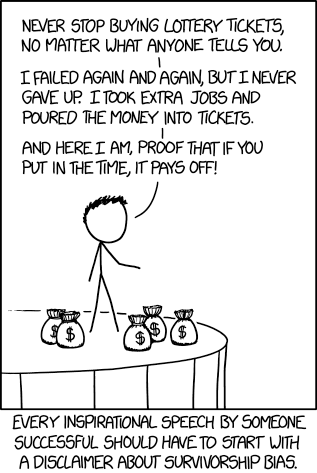
Source: XKCD (https://xkcd.com/1827/)
This is disturbingly relevant to those considering medicine, or those already in it. There are countless stories from people who have "made it", sharing their path to medicine and encouraging others to duplicate it. Some of these have merit. Many do not. The problem, as the XKCD comic notes, is the survivorship bias. There are many paths to and through medicine, but some are more risky than others. Those who achieve what could be considered to be a success naturally think they've got the inside track on how to become successful, because hey, it worked for them! I'm definitely guilty of this myself. Yet anecdotes are not data and what works for one person won't necessarily work for all people.
In medicine, the most common example of survivorship bias comes when considering attending medical school outside of Canada. It works for some people, people who are naturally pretty happy with the choice they made. Yet, we don't hear much from those who did not find success at a foreign medical school, who are understandably fairly shy about talking about their failures.
There are countless other situations where this holds true, however. There are many Canadian medical students who took some non-traditional paths to medicine. I did a second degree, for example. Others took comparatively difficult undergrads, such as engineering or art. Yet, while these paths work for some, I wouldn't call them reliable or optimal pathways to medicine.
I'd put CaRMS matching for Canadian medical students into this category as well. Successful candidates share their approach to matching to competitive programs, while those who didn't match, or matched low on their list generally don't share their often-very-similar stories.
The problem is that anecdotal data is often all students have to guide them. There isn't great data out there to say how to get into medical, how to land a good residency spot, or on the outcomes of studying medicine abroad. This is just my small reminder to treat every success story with a grain of salt, and to always, always, always have a reasonably reliable back-up plan in mind. Risk-taking is part of having a good career, as the only paths in life that come with guarantees are ones of mediocrity, yet gambling the future away in hopes of a payoff is never a recommended approach. Take the risks that still leave you standing if they don't work out - so that you can take the next chance that comes your way after that.
Subscribe to:
Posts (Atom)